Events from Mar 84 to Jun 86
The Darkness Is Coming
Preparations for Season 22 had started as early as late 1983 with the planning of a new Cybermen tale as a high-impact opener. Producer John Nathan-Turner was keen to bring back some older foes for the season and along with the Cybermen, the Sontarans, the Master and the Daleks would appear. JNT wanted to end the season on a high too, and so the Daleks were chosen to end the production run.
Graeme Harper directing the Daleks
Eric Saward was unhappy with his handling of the Daleks in Resurrection of the Daleks feeling the story was overly complex with too many story strands. He felt he could do much better and over the summer months of 1984, while on holiday, he prepared a new story inspired by Evelyn Waugh’s play The Loved One. The play had some dark tones that he felt he could bring into Doctor Who, and officially the script was commissioned in November 1984. Work on the production side had advanced quickly and Revelation of Daleks, as it became known, went into pre-production in the same month.
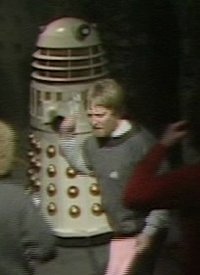
The director assigned to the story was Graeme Harper who had impressed the previous season directing The Caves of Androzani – Peter Davison’s final story. Caves also had some darker moments itself, dealing with subjects such as gun-running and drug use. Harper wanted to get the best from the Daleks and was enthused by JNT’s notion of dispelling an old Dalek myth.
Growing Daleks
One of the new Daleks at the Liverpool Festival. Photo – Kathleen Griggs
Between May and October 1984 the first International Garden Festival was held in Liverpool. It was an effort, devised by Conservative Minister Michael Heseltine, to regenerate tourism in the Liverpool area which had been in decline for some years. The event was not unlike the Chelsea Flower Show although the idea perhaps used more contemporary themes and the many gardens that covered the huge site used all sorts of art or interactive elements.
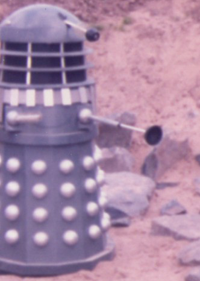
The BBC had their own area within the show consisting of a large tent filled with TV props and BBC Micro computers for the public to play with. Outside the tent was a Doctor Who themed area that included a TARDIS and K-9 prop along with three Daleks of a new design. The area was designed by Martin Wilkie and Lorne Martin who had been designing exhibitions for the BBC for a number of years.
Since the very early days of Doctor Who, Dalek props had been loaned out to private events and exhibitions, with the Longleat and Blackpool exhibitions even receiving their own specially-made props of a slightly different design. The three new props on display at the Liverpool festival also departed from the exact shape of the TV originals as a new set of fibreglass moulds had been created by the BBC Plaster shop allowing quick fabrication of skirt and shoulder sections.
The skirt front was steeper than a standard prop, with smaller hemispheres that were spaced further from the skirt’s top and bottom edges. The fender section was now moulded to the bottom of the skirt and included a ‘double staged’ look with the lower half being recessed. The shoulders were moulded to include a lower collar and whist the boxes were also moulded a wooden ‘plate’ was inserted through the front section to complete them. Holes were cut through for the pivots and the pivot retainers were screwed into the rear of the plate which formed some imperfections on the outside. The complete shoulders were slightly shorter and broader than usual and when coupled with the skirt the outline was of a stockier and less sleek Dalek. The neck and dome of the festival props were over-large, giving the whole prop a slightly comical look to the trained eye. One of the Daleks was made to look battle damaged, with a hole in the side revealing the inner workings.
The new Necros One and Necros Two
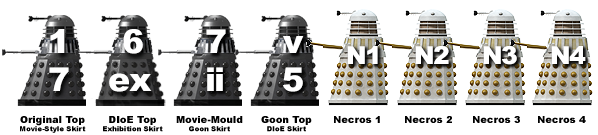
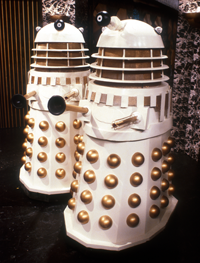
From this available source of new moulds the BBC were able to produce a batch of new Daleks, four of which would star in Revelation of the Daleks. Despite their origins starting in spring 1984, this group are termed Necros props after the home planet of their creation and first screen use. For their TV appearance, revisions were made to the head and neck section so that it conformed better to the appearance of the original Daleks. The casings were painted in a white finish with gold highlights. Despite looking brand new at first glance, on closer inspection the props are rather hastily put together, with misaligned slats and wear and tear on the body. This meant that like their older counterparts they each show unique differences which can be tracked.
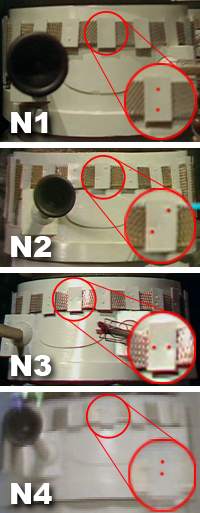
The various rivet alignments on the front slat
The first clear difference that can be seen is in the slats around the shoulder section with the centre front small slat being the most obvious. Dalek Necros One, or Dalek N1 for short, has the slat riveted to the collar in the usual vertical pattern, whereas Dalek N2 has the rivets spaced diagonally and Dalek N3 horizontally. Dalek N4’s were similarly laid out to Dalek N1 but were positioned much closer together. The rear centre slat of Dalek N2 also had a diagonal pattern, whilst Dalek N3’s complete set of slats are more haphazardly aligned and riveted than the other three props.
Although the neck cages were made to resemble the older style cages better than the Liverpool Festival props, there were still issues. The rings were made with with various widths, thicknesses and chamfers and due to them being made in sections they had fixing blocks attached to the underside at various points. The cage itself was raised from the shoulder and held in place by black screws. As with their older Dalek brothers, this was to hide the elevation of the dome on the A-Frame. There were apparent chips in the paint even in early scenes.

The new props still showed various quirks
Dalek N1 had a large chip in its oval between the gunboxes and the lamination on the armbox of Dalek N2 was bent upwards at the corner. The gun and arm boxes of all the props showed several lumps around the pivots due to the internal pivot retaining screws with Dalek N3s being particularly noticeable. Dalek’s N1, 2 and 3, despite having the new style moulded fender, had a rubber drape tacked around the outside to hide the underside of the skirt.
The four skirts also had traceable features and a long standing issue of misaligned hemispheres was repeated again. Rather than being pushed through from the inside as per the original Shawcraft props, the hemispheres were bolted through from the front resulting in all four skirts having unique hemisphere layouts particularly on the front two panels.
At least one more skirt was produced and used for SFX scenes. This skirt had various lightweight sections placed on top for destruction purposes (the lightweight shoulders are easily spotted as they used gold gun and arm pivots instead of the usual white). This skirt is also visible in the DJ’s studio scene and has its lower fender section coloured black.
Flying Daleks
Three locations were chosen for the exterior filming of the episodes – The IBM building at North Harbour near Portsmouth, Tangmere aerodrome near Chichester and Queen Elizabeth Country Park near Petersfield.

The specially made skirt section in the van on location. Photo – Tim Wearing
JNT was keen to dispel the myth that Daleks couldn’t climb stairs, and so Saward included sections within his script that would see Daleks hovering. A battle sequence was planned where the characters of Orcini and Bostock would encounter a Dalek patrol, and after an exchange of fire one of the Daleks would be seen to hover prior to exploding.
A specially made SFX Dalek skirt section was made for the exterior sequences and included two panels that could be removed or blown off to see interior detailing and the remains of a human/alien mutant was placed on the top surface. Extra elements were also added to the underside as it was due to been seen from a low position.

An FX Dalek about to go up in smoke
On the morning of the first day’s shooting the crew awoke to a covering of snow which ended all hopes of getting the planned shots. The catapult needed to fire one of the SFX Daleks into the air could not reach the location and the idea had to be dropped. Harper and crew quickly found a new location that had an interesting look – the aforementioned aerodrome – and so the Dalek was ‘destroyed’ on the ground at the aerodrome instead.
The snow changed many of the shots during the filming and in the event only one brief scene with a new prop could be filmed outdoors.
Growing Daleks II
Studio taping got underway a little under two weeks later on 17th January, with the first session ending on the 18th. The second block ran from 30th January until 1st February.

The only instance of the three main Necros props together
Seven hero Daleks of different kinds would be utilized throughout the story. Saward had continued a thread from his previous Dalek tale and created a Dalek faction loyal to Davros himself. The new Necros props would fulfil this role although Dalek N1 and Dalek N2 were used to carry most of the work. Dalek N3 was only seen together with Dalek N1 and Dalek N2 in two scenes – on the view screen in the DJ’s studio after they are dispatched to kill him and the scenes of Orcini’s attack on the fake Davros. The shot on the view screen is the only instance of the three Daleks together in one shot.

Dalek N4 gets a very brief appearance before getting destroyed
The fourth Dalek, Dalek N4, was used solely as an SFX prop in one scene and comprised of a skirt and shoulder section only. A lightweight neck and dome section was created to sit on top of the prop which, on cue, was blown up. Interestingly the fender section had black tape wrapped around the outside instead of the rubber that the other main three Necros Daleks had. The single appearance came in the DJs studio. Dalek N4was filmed getting blown up from two different angles with the resulting footage being cut into the scenes of Dalek N3 attacking the studio to give the impression that two other Daleks were destroyed. The SFX skirt was also used here along with a pre-destroyed top section and acted as the first Dalek to be destroyed.
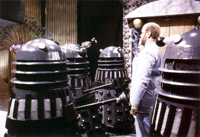
The Daleks loyal to the Supreme
The Daleks loyal to the Supreme Dalek would be played by the same four props as had featured in Resurrection of the Daleks. They were in the same component mix as before with the exception that Dalek One-7 and Dalek Six-ex had swapped necks with Dalek One-7 now having the ‘Shawcraft style’ neck cage and Dalek Six-ex having the simpler Goon version. The same four domes used in Resurrection of the Daleks were re-used but they swap between props even in the few scenes in which these Daleks were used.
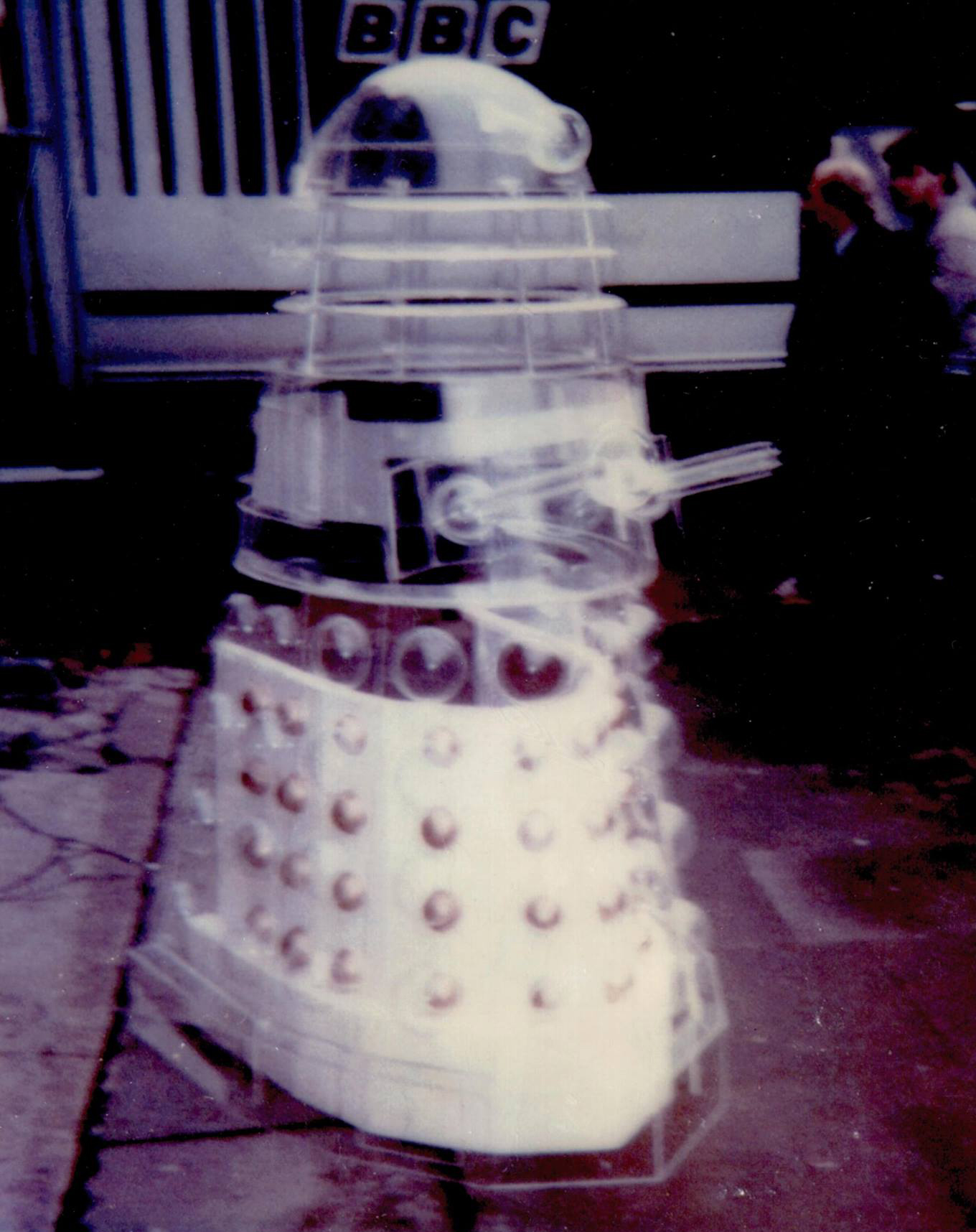
The perspex Dalek prop at Denny’s. Photo – Linda Calvert. Please click for a larger view.
Initially, in his guise as The Great Healer, only Davros’ head was seen. He was positioned in a glass tank located in the centre of his lair. In the story, it transpires that this is a decoy, and the real Davros appears at the climax of the tale. Once again Terry Molloy played the Daleks’ creator.

The ‘glass’ Dalek in the incubation room
One of the grizzlier elements of the story called for the new Daleks to be grown from humans. These Daleks would be incubated within a glass Dalek. The idea of a Dalek with glass elements was first mooted in 1963 but dropped due to budget issues. The glass Dalek in Revelation of the Daleks was in fact realised using perspex and the embryo elements were housed inside to help hide certain parts of the actor’s body. The manufacture of the perspex sections was out-sourced to R Denny & Co in Netherwood Road, a local company in Shepherd’s Bush. Denny’s were responsible for many BBC props made in perspex, including a Blue Peter ship and the “Arena” letters in a bottle for the title sequence of Arena1. The ‘solid’ white Dalek sections were specially made by John Brace in the SFX department and slotted in via the rear. A vacuum-formed version of the prop was used when it was destroyed.

The ‘Sevans’ model Dalek
After having to abort the hovering Daleks on location, Harper was keen to make sure the effect was achieved in studio. He decided that attempting the scene with a full sized prop wouldn’t be viable and so he used one of the commercially available Dalek models made by Stuart Evans’ company Sevans. The model was painted to match the new Necros Daleks, and it was video taped at the appropriate angle and then overlayed into the scene. Unfortunately however the finished product doesn’t quite give the effect Harper was trying to achieve and the viewer was left confused as to what was happening. This was corrected on the DVD release many years later when another Sevans model was superimposed over the raw footage to give the correct perspective. Davros was seen to hover too, and this effect was flawed by superimposing Terry Molloy, who was supposedly in the background, on top of the raised leg of the prone Orcini in the foreground.
Director Graeme Harper was keen to include a couple of tight shots showing humans menaced closely by Daleks. The large diameter of the Daleks’ casings made it impossible to frame all the actors and props together, so Harper used unattached eye-stalks which could be hand-held and moved into view of the camera.
Journey’s End

Dalek Six-ex outside the Blackpool Exhibition
Revelation of the Daleks would be the last screen use for two of the long-standing Dalek props. Dalek v-5 was retired and was never seen again. It was also to be Dalek Six-ex’s last Doctor Who appearance, although it has never fully disappeared from the Dalek scene. After Revelation of the Daleks it was moved to the Blackpool exhibition where it stood outside the entrance for visitors to have their picture taken with. It was left out in all weather and quickly deteriorated with the neck rings suffering in particular.

Dalek One-7 and Dalek N2 on show at Longleat. Photos – Jon Green
Dalek One-7 and Dalek N2 were dispatched to Longleat where they were displayed in the BBC shop that was located near the exhibition. Again the public were invited to have pictures taken with the props. Dalek N2 already had a hastily chosen new eye to replace the missing original and the lamination of the armbox had been completely torn off.
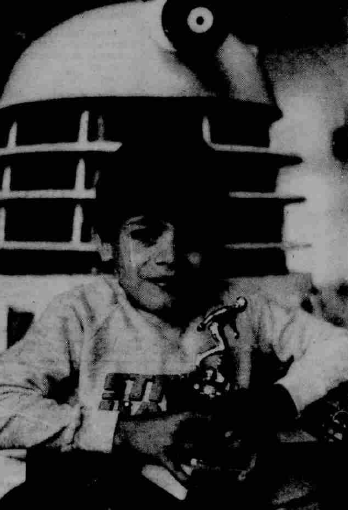
A Necros Dalek visits Hobbayne School in Ealing for their prize day. 16th July 1985. Click for a larger view.
In August 1985 John Nathan-Turner was due to appear at the Edinburgh Book Festival. He decided that he would take a Dalek with him and Dalek N1 was selected for this task. Ever the opportunist, JNT decided to set-up a photocall at Kings Cross station and various pictures were taken of himself with the Dalek and the Dalek attempting to board the train.

Dalek N1 boards a train at Kings Cross
May 1986 saw the launch of a travelling exhibition of Doctor Who items to the USA. The tour had taken some months to organise in which a huge truck which was filled with exhibits. The outside of the trailer was covered with a painting by Andrew Skilleter who was a prolific Doctor Who artist at the time. No exhibition would be complete without a Dalek and so Mike Tucker of BBC VFX was called upon to refurbish Dalek N1. During November and December 1985, the chip in the oval was repaired, the mesh tidied and the prop was given a new coat of gloss white paint with gold highlights. A new eye with a unique pupil design was also fitted. The prop was passed into the hands of another technician who then fitted an internal movement mechanism to rotate the dome and move the eye and gun stick.
In June 1986 Dalek Six-ex reappeared on television. The radio show Women’s Hour had teamed up with the Red Cross to raise money for Sudan and Christie’s in London were holding an auction of various items donated by famous personalities and organisations. Dalek Six-ex was being donated by the BBC and was expected to raise in excess of £3000.
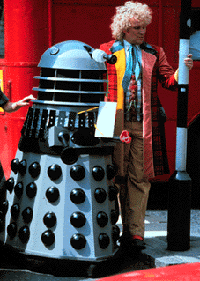
A refurbished Dalek Six-ex, auctioned in 1986. Click image to see a video
The prop had undergone some heavy refurbishment for the sale, with a new coat of paint, and larger oval which covered the unsightly four bolts on the shoulders. The Blackpool exhibition had closed down the year before and a number of the components from an exhibition prop had been used to restore the Dalek. More information can be found on our ‘Exhibition Daleks‘ page.The dome was one of the remaining Goon domes from the pool of spares.
The sale generated much interest from television and the press and yet again the strange looking Dalek received a major public viewing. The BBC themselves used the opportunity for some self promotion and the prop featured on news items throughout the day. It wasn’t the last time this particular Dalek would see an auction house.
Big changes were afoot at the end of season 22. The BBC were unhappy with Doctor Who and it was placed into an 18 month hiatus to rethink the show. When it returned the new season was dogged by many off-screen problems, including the sacking of the lead star and a fall out between Eric Saward and JNT resulting in the departure of the script editor. The vacant post was filled by Andrew Cartmel who had plans for the show that would take it into a new direction and style.
Next Page: Remembrance of the Daleks
-
Thank you to Linda Calvert