The First Motion Picture
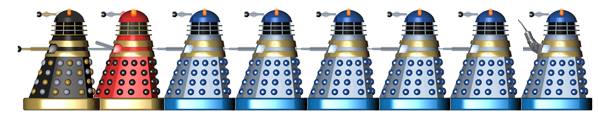
A New Breed of Dalek
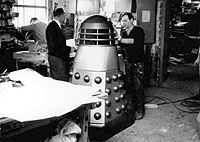
A brand new film Dalek being fabricated at Shawcraft
During the Dalekmania of Christmas 1964, two film producers called Joe Vegoda and Milton Subotsky secured the rights to produce a Dalek film based on the first television adventure. With Terry Nation already busy writing the third television serial for his metal creations, Subotsky himself worked on the film script, with some input from David Whitaker. Production was to be handled by one of Vegoda’s production companies, AARU, affording it an unusually large budget of £180,000.
Cast and crew were assembled in January 1965 and, with William Hartnell tied to his BBC contract, the lead role was given to Peter Cushing. Cushing was a stalwart of the horror films which were very much associated with Amicus, a company of which Subotsky was a director.
The production company AARU required a set of their own Daleks to be built and naturally turned to the company which had produced the original BBC props: Shawcraft.
In February 1965 Shawcraft began work on the new batch of Daleks and it took them roughly one month to complete eight props at an average cost of approximately £350 each.
Director Gordon Flemyng wanted his vision of the adventure to be bolder and brighter than the TV serial, and this was reflected in the appearance of the Daleks. The new props were given the type of enlarged fenders that had been used in the most recent television serial, The Dalek Invasion of Earth. They had simplified guns and large dark orange lights o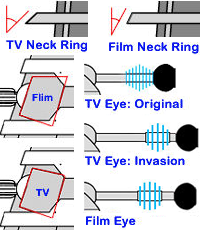 n the domes. The opportunity was taken to reinstate one of Raymond Cusick’s original ideas which was to give some Daleks pincers rather than suckers.
With a Dalek-heavy future on the horizon, and with a tight deadline, Shawcraft took the opportunity to refine their construction techniques, making it quicker and easier to form certain sections.
There were a variety of minor differences with this new batch, such as the angle of the chamfer on the neck rings becoming steeper, and the eye-discs being set slightly further back. The bottom of the eye slot was squared off and stopped higher on movie Daleks, whereas TV props had a rounded slot.
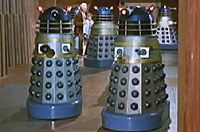
Film Daleks
As well as these small differences there was an important change in the construction of the gunboxes. Shawcraft created gunboxes from fibreglass instead of wood resulting in a “complete” fibreglass unit. To facilitate pulling the casts from the mould, a change was made to the geometry of the gunboxes whereby the top of the box became parallel to the ground – generally referred to as the “flat-top” gunbox shape. But one particular alteration to the fabrication process resulted in a feature which would become infamous…
The Infamous Hemisphere Misalignment
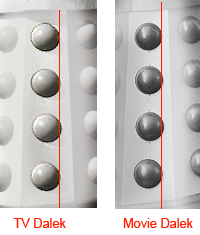
The 3rd hemisphere down is always off to the right
When a pair of new props had been made the previous year for the TV story The Dalek Invasion of Earth, Shawcraft had tweaked their method for targeting the hemisphere holes on certain panels. The same method had been employed for positioning the holes on every skirt, and so any quirks in the system were carried through all the props.
For example, on the first front panel of the left-hand side, every single prop since 1963 featured a very subtle misalignment whereby the middle two hemispheres are shifted slightly to the right. When Dalek Five and Dalek Six were constructed in 1964, the panels at the rear had their hole positions altered – however the right-shifted hemis on the front panels remained as they were.
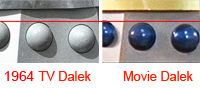
The hemi on the side panel is set too low from 1964
As well as having more “upright” rear columns, Shawcraft’s tweak to the hole-targeting system in 1964 also resulted in the top hemisphere of the left side panel dropping slightly lower than it should have have been, so both Dalek Five and Dalek Six have a distinctive low hemi on the side.
When Shawcraft came to build the new batch of movie props in 1965 the hole-targeting system was adjusted again, but only on the rear-left corner and back panels. The new positioning had the most noticeable error yet – the top hemispheres were positioned too high. Unfortunately, these props already carried the adjacent low hemi from the last batch, and the result was a profoundly uneven top row combination of low and high hemispheres.
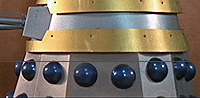
The side hemis already being too low makes the new rear corner position look even worse
The hemisphere hole-pattern would hereafter remain unchanged, and thus all future Shawcraft Daleks would retain a number of quirks which had emerged at different times: They displayed the right-shifted front hemis present since 1963, the low side-hemi and “upright” rear columns from 1964, plus the high corner and rear hemis from 1965.
Whilst these very obvious features were present in all eight new props, as usual each Dalek displayed its own unique features which allow us to number and track them throughout the film, and then on into the future.
The Eight Hero Props
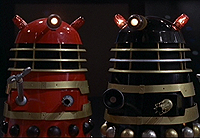
AARUs One and Two were Black and Red
Production got underway at Shepperton on Friday 12th March 1965 for which the eight “hero” props were utilised together on set as effectively as possible.
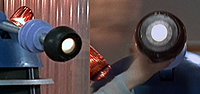
AARUs One, Two and Three had a variable iris
The Daleks’ livery was designed to take full advantage of the colour format of the motion picture and thus the paint schemes provide the obvious way to distinguish the first two props. As became traditional, a Black Dalek was leader, possessing a sucker-arm, and its neck rings and skirt hemis were painted an alternating gold and silver. This will be referred to as AARU One. The second-in-command was a Red Dalek with gold trim and black hemis, possessing a pincer claw, which is AARU Two. There was a unique “specialist” Dalek, plus five more standard “drone” props painted in identical two-tone blue with gold collars. We must look to more subtle differences to tell the drones apart apart.
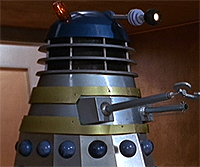
AARU Three has a sag beneath the arm box
AARU 3 is the main “drone” Dalek in the film, used prominently in most scenes with one of the three experienced television operators inside. Along with the two leaders, this prop was the only one to have a camera’s iris mounted inside the eye. The prop can also be distinguished by a slight sag of the lower collar underneath the armbox, and it was one of only two drones to be given a pincer. The gun of this prop also has the curious feature that its bottom rail is blackened in various places.
It is AARU 3 which takes the fluid link from the Doctor at the start, brings food to the prisoners and is then attacked, opens the lift as the prisoners bluff their way out, flips the lid off Ian’s destroyed Dalek, reports to the Black Dalek in the control room, and chases the Thals near the lift.
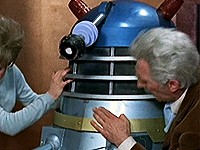
AARU Four has a hinge just beneath the neck
Although it is AARU 3 which the prisoners deactivate by pulling it onto Susan’s cape, the moment the Dalek becomes immobile, the prop is switched to that of AARU 4. This fourth prop has modifications which allow the neck and head to be hinged open, and cables prevent the top from swinging too far. The prominent hinge at the front is the easiest way to distinguish this prop, although it also has a noticeable spray of white around its neck for the majority of the film. It is the only other drone with a pincer.
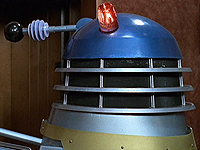
AARU Five has a neck mounted too far back
When AARU 5 was initially brought in for the filming of a couple of scenes, it looked perfectly normal. However, following the removal and re-attachment of the top of the prop, the neck was not aligned correctly and it is re-mounted too far back on the shoulders. This rather precarious appearance with a massive overhang at the rear is then present throughout the rest of its scenes and in appearances after the film. Another feature of this prop is that the top collar is badly misaligned, with a diagonal slant towards the back and an upward lift on the right side. It is one of three drones to have a sucker attachment.
AARU 6 is generally used only in the background of the control room and can be distinguished by a large horizontal scuff in the rear-right of the shoulders between the collars. It has a sucker attachment.
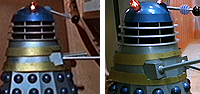
AARUs Six and Seven are rarely seen
AARU 7 only makes one noteworthy appearance at the climax when Ian turns it to face another Dalek, resulting in mutual extermination. It has no especially distinctive characteristics but its collar screws have a particular configuration. It also has a sucker attachment.
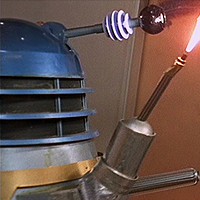
AARU Eight – The Blow-Torch Dalek with blue neck
AARU 8 is a very unusual prop for a number of reasons. In the scene where the Daleks cut through the lift door, this prop is brought forth with an Oxyacetylene cutting torch for an arm. But as well as the obvious appendage this prop has numerous unique features. Unlike all the other movie Daleks, the neck cage is painted blue instead of silver. Its collars are a more copper/bronze colour rather than gold of the others. And, strangest of all, the condition of the prop is terrible. The head is dirty and smeared. The neck is covered with a viscous substance which has run down the shoulders, and some of the hemispheres have caved in.
Despite the strange nature of AARU 8, it is used throughout the film, but usually with its torch-arm hidden from view. It is on the far left in the opening shot of the Daleks encircling the time-travellers, it is in the chanting scene, and it is in the background in the control room – always easy to spot once you look out for blue neck rings.
Although these eight hero props performed all the key work, there were battle scenes and crowds of Daleks for which large numbers of props would be needed. For this purpose, a different type of prop had been created…
Background Daleks
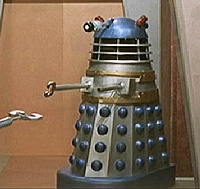
A dummy Dalek
For some FX shots, such as the destruction of the Dalek control room, and also the crowd scenes there afterits destruction, a batch of 10 Dalek ‘extras’ were made. Technically these were the first Daleks not to be built by Shawcraft, as they were created at the Plaster shop at Shepperton studios at a cost of £100 each.
The extras were relatively sophisticated, possessing fully-poseable limbs and flashing lights, but they were cast in large chunks instead of having individual components. They were used most famously in the chanting scene filling up the rear ranks of the Dalek numbers, but they also crop up in scenes were a Dalek is blown up, and also when one is pushed down an open lift shaft.
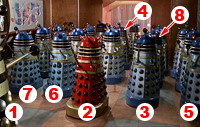
The hero props and dummies together for chanting
When seen close up, the moulded nature of the props is easy to spot, since the collars are an extrusion of the shoulders, and the neck is a solid block with the ring and rod details merely a raised surface picked out in paint. At a distance however they looked effective, but can be distinguished at a glance because the collars behind the gunboxes have their inside edges pointing forwards instead of following the line back, giving them a distinctive zig-zag look.
The paint scheme on these props was also subtly different to the main props. The blue used on the head and hemispheres had a touch more red in it, resulting in a slightly purpley shade which looked lighter than the hero props. The finish was also more metallic which meant that under certain lighting conditions would look completely pale in black and white photographs.
Shooting on Dr Who and the Daleks was completed on 23rd April 1965, by which time the publicity was already in full swing. Three Dalek operators with television experience (Robert Jewell, Gerald Taylor and Kevin Manser) had been hired to be the principals in charge of prop movement, and they went straight from Shepperton to rehearsals for yet another Dalek production…
Cut to The Chase
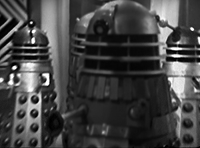
AARU Six and AARU Five on the set of The Chase
Just as shooting wrapped on the film, the production team for the Doctor Who TV show was preparing their own Dalek adventure, The Chase. This story was intended as something of a blockbuster – even if the budget didn’t fulfil this ambition – and the script featured a multitude of planets, time-periods, different aliens, and even a cameo from The Beatles.
As a means of bolstering the Daleks’ ranks, the new props from the movie were made available to the BBC, and three were hired. AARU Five, AARU Six and AARU Seven arrived at Riverside studios on 14th May for episode three of The Chase.
Movie Daleks have small lights in episode 3
It was immediately apparent that the three taller Technicolour movie props did not blend in with the original TV props. But as the new arrivals did not belong to the BBC, and with neither time nor money readily available, the only attempt made to address their appearance was to remove the large fender and swap the large beaker lights for normal TV domes.
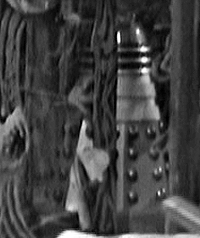
Movie Dalek in studio on 28th May
There were no additional Dalek operators, but without fenders the props had no means of movement anyway, so the props were stationed in three places around the edge of the Dalek time machine. AARU Five was placed to the right of a ramp, with its incorrectly-mounted neck quite obvious, and AARU Six on the other side. AARU Seven is barely glimpsed on screen, at the far left of the set.
The three props then had a week away from the studios and were not present for recording of episode four on 21st May. They returned the following week for recording of episode five on 28th May, having been restored to their original movie appearance with large lights and big fender. They can be seen in the back ground of the jungle – considerably taller than the TV Daleks.
But whilst these three hero props had been working, the other five props had been on holiday…
Promoting the Film
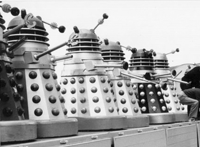
Daleks being loaded up for the road journey to Cannes
There was a great deal of publicity for the Daleks’ big-screen debut, starting with BBC interviews with the cast whilst the film was still being shot. Then, on 17th May, a dozen of the props were loaded onto a truck ready for a long journey to the south of France.
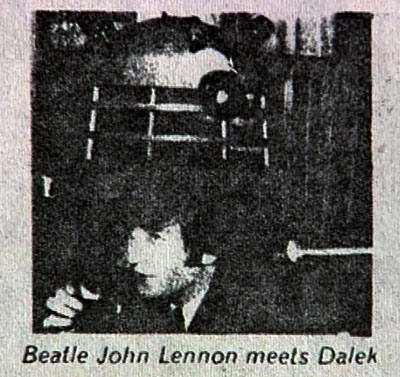
John Lennon ‘meets’ a Dalek at the British Reception in Cannes
The collection which was readied to go abroad comprised five hero props, and the rest were the dummies. The Black AARU One and Red AARU Two were taken, as was the unusual AARU Eight with its blowtorch arm. The two standard drones were AARU Three and AARU Four, now with its pincer replaced with a sucker.
Three days later they arrived for the Cannes Film Festival and numerous publicity photos were taken showing the Daleks in the street.
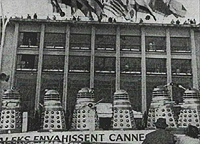
A dozen props at the Cannes film festival, 20-28th May
The Cannes publicity images reveal the blow-torch AARU Eight had considerable damage. It had not been in good condition on-set but, following the long road journey, its light covers were missing, many of the skirt hemispheres had caved in or dropped out and the fender was very badly scuffed. The other props were also showing signs of wear. The festival ran until the 28th May.
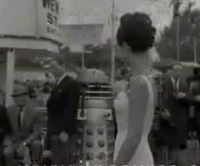
AARU Seven at the Variety Club Gala, 29th May
On the 29th May, the day after the Cannes Film Festival closed, Daleks were needed for the Variety Club Star Gala. This annual event featured many stars of the day and this year featured Liz Frazer, Michael Caine, Bernie Winters, The Beverley Sisters, Stanley Baxter and Cilla Black all present for the day. One of the Daleks supplied was AARU Seven and, with erect plunger, it is seen judging the beauty contest in archive footage. This prop had been in use at Riverside studios the previous day for recording of The Chase.
The film Dr Who and the Daleks premiered on 24th June, two days before the final episode of The Chase was broadcast on television. In addition to the boost from the TV serial, the producers went to great efforts to organise coverage in newspapers and comics, and hype up the film with posters showing long queues outside the cinema.
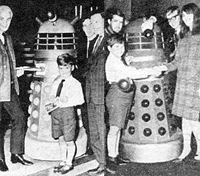
Keith Stark and Anthony Barber with their prizes – a dummy and AARU Five.
One of several Dalek-related promotions was in TV21 comic which offered the chance to win a real Dalek to lucky winners. A photo shows the publicity for the launch of the competition taken in July 1965. The Daleks attending are two of the dummy props. The prop won by Keith Stark of South Woodford was a dummy and its different paint-job appears quite pale in the photos.
The Red Dalek won by Anthony Barber was not the genuine AARU Two (which continued to make publicity appearances) but its distinctive neck misalignment and angled top collar reveal it to be a repainted AARU Five.
Terence Worall also won a fully-working hero prop but again not the one it purported to be. The real Black AARU One continued to appear elsewhere and in fact young Terence took home a repainted AARU Six, as indicated by its screw positions.
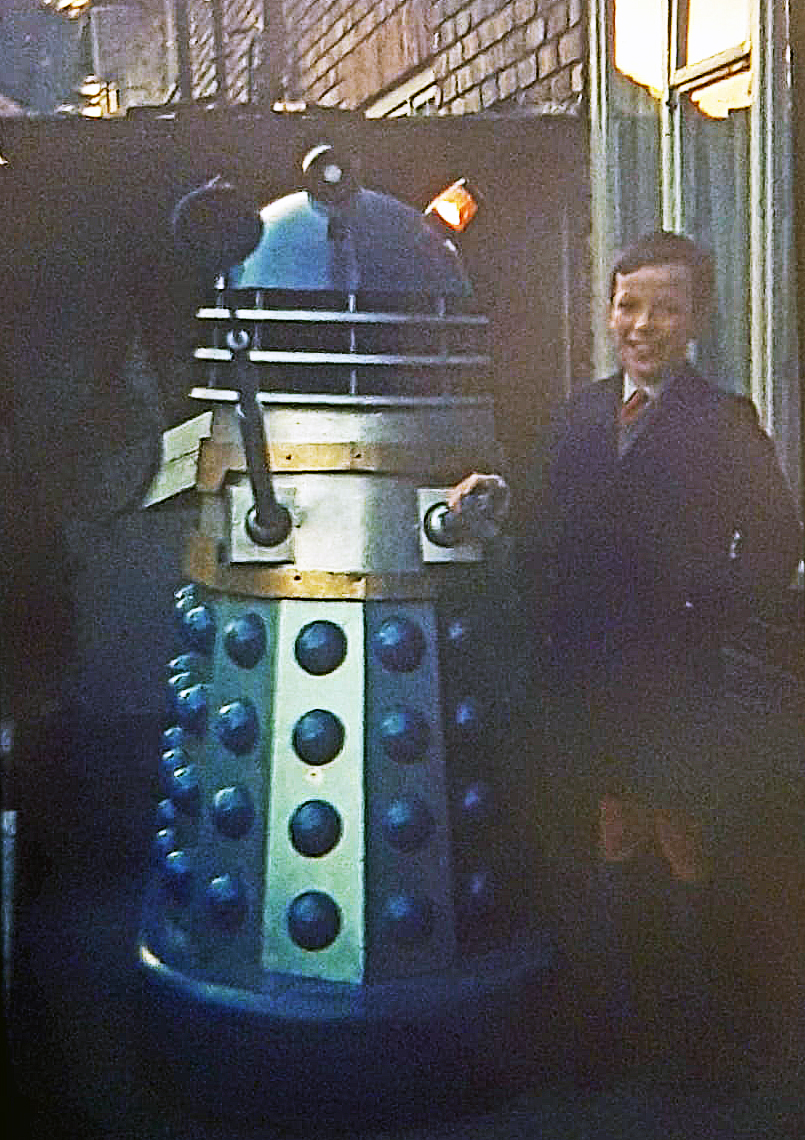
Robert Rankin’s prize, AARU Seven. Robert is inside the Dalek operating the lights and his cousin is pictured with the Dalek. Picture – Robert Rankin. Click for a larger view.
The Liverpool Echo also ran a competition, in August, affording readers the opportunity to win a real Dalek. The event was run in conjunction with the Lewis’s store in Liverpool where a display promoting the movie had just been set up. The competition involved ranking cartoon characters.
Fourteen year old Robert Rankin was the lucky winner and was photographed with AARU2 at the Lewis’s store in mid-August. The Dalek he actually received when it had completed its duties, was AARU Seven. Once the Dalek was home, Robert added a hinge to the neck section to allow him to enter the prop without having to lift the whole top half.
Anthony, Terence and Robert were lucky enough to win Daleks that had appeared on the big screen as well as in The Chase.
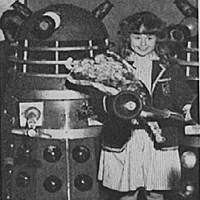
Roberta Tovey and Daleks in Manchester, August
The Daleks’ national tour featured not only the props themselves but elements of the sets from the film. At the beginning of August a “Dalek City” was opened in Selfridges, London. Despite the missing eye-stalk the prop (a dummy extra with its distinctive zig-zag collars) was seen in relatively good condition. Roberta Tovey visited both Manchester and Birmingham around the time of her birthday and the Daleks were always in attendance including the real Black AARU One and Red Dalek AARU Two from the film.1 By this time, some repair work had been done and both these props had lost their original lights. As with the original light-covers, the replacements were plastic beakers and the new ones featured a large lip at the base of the glass (which became the top of the light).
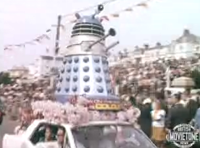
A flowery Dalek promoting in Jersey, August
2nd August saw one of the more enterprising efforts at promoting the film. The Jersey Battle of the Flowers first took place on 9th August 1902 in Jersey, as a celebration for the coronation of Edward VII and continued annually ever since stopping only occasionally during the war years.
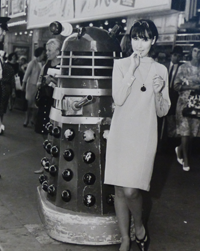
A repainted AARU Three in Sydney in 1965. Picture – Fairfax
The event featured a huge procession of floats with a floral theme. It was an unusual place to come across an alien invader but nonetheless a car appeared covered with flowers, with a Dalek on top and advertising boards publicised the new film.
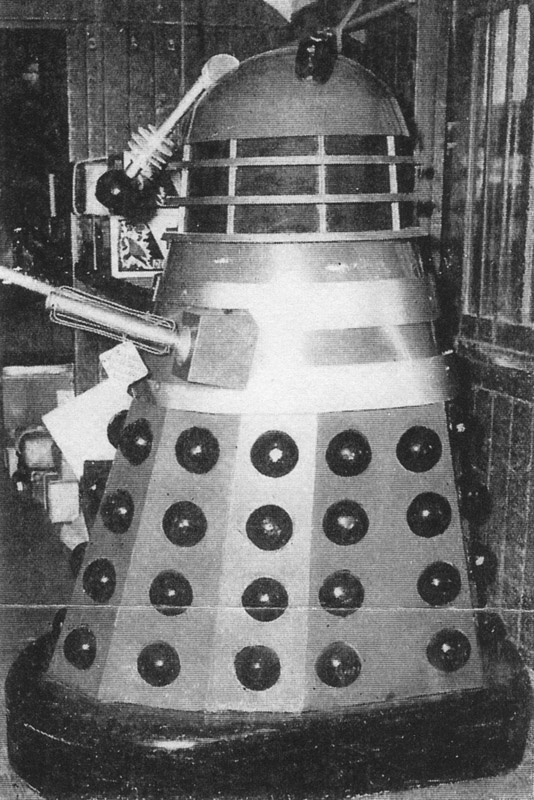
AARU Three in Melbourne in 1966. Click for a larger view.
Promotion overseas ran as far as Australia where the TV series of Doctor Who had begun broadcasting in the January of 1965. Viewers there were already acquainted with the Daleks and so when AARU Three appeared in Sydney in December 1965 it was greeted with much joy rather than bewilderment.
The prop had been repainted to mimic the red leader AARU Two but had suffered somewhat in transit. It had lost its claw and the new paint scheme was already dented and scraped away in places.
Several weeks later, the same prop was photographed in Melbourne at the Spencer Street station where it was awaiting transit to Ballarat. It had been given a spruce up since its time in Sydney with its hemispheres touched up and the fender now completely black. Although its eyestalk was now hanging limply from the pivot2.
After the Film
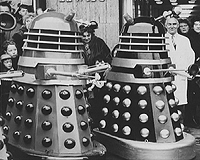
Lewis’s in 1966
Even once the initial film frenzy had passed, the guest appearances did not stop. The leaders AARU One and AARU Two as well as AARU Four attended Lewis’s in Stoke-on-Trent in 1966. By this stage the props had had repaints which departed from their film appearance, with the Red AARU Two‘s fender now black instead of gold, and the blue AARU Four‘s hemispheres were now black. All three props sported the non-standard replacement lights with the large lip.
Despite the repaints, the props’ condition was deteriorating and some sub-standard refurbishments had been done in addition to the new lights. Both the leader Daleks had only two eye-rings left intact, and ugly, white cone-shaped additions had been made to the end of the eye-balls. The Black AARU One‘s arm had been reduced to the thin interior rod, the Red AARU Two‘s pincer had half missing, and loops had been drilled into the fenders to tow the props along.
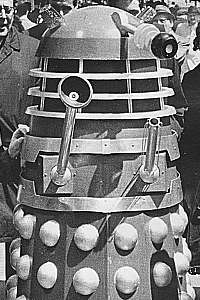
A Dalek in New York, July 1966
Another photo from May 1966 reveals one final sub-plot. It was taken in New York, outside the Empire State Building as part of a publicity stunt featuring a college girl, to promote the release of Dr Who and the Daleks in America a year after it had been released in Britain.
The new-looking Dalek is painted red with plunger, yet another new style of lights, and silver hemispheres. Whilst ostensibly resembling a prop from the first movie, in the finer detail it is not built as such. The collar screws are not configured correctly and, more significantly, it sports a prominent seam down the front of the gunboxes. These seams were created in the mould and thus appear on every set of shoulders cast. For the first film, they were all sanded completely away with the exception of the Black Dalek AARU One whose seam was only half removed.
The complete seam on USA prop proves it was made after the February 1965 batch, and is not one of the hero Daleks from the first film.3 This silver and red prop is therefore AARU Nine.
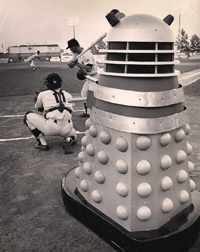
Aaru Ten plays baseball with the Columbus Yankees
Photographic evidence suggests at least two Daleks were sent to the USA to promote the film. The second is painted in the standard ‘drone’ scheme and appeared with baseball team ‘Columbus Yankees’ in Georgia. The photo is dated 1st June 1966 and the pristine nature of the prop along with lights that match AARU Nine suggests it was also a brand new build. This prop is AARU Ten.
Dr Who and the Daleks was a modest success for Milton Subotsky and Joe Vegoda, but it was helped by a resurgence in popularity of the metal aliens when they has returned to the small screen for the third time in the month preceding the film’s release. The production of The Chase was closely linked to the theatrical production and the television props had been forever changed by the arrival of their Technicolour cousins.
-
The screws affixing the front of the upper collar are extremely distinctive on the Red Dalek seen in the film. On the Black Dalek for example, the screws over the gunboxes are a fairly typical 27cm apart, whereas on the Red Dalek, there are a mere 16.5cm apart. This narrow configuration is present on all publicity photos of the Red Hero Dalek well into 1966, proving it was not one of ones given away.
-
Thank you to David McKinlay for the image of AARU Three in Melbourne from “Victorian Railways” Newsletter February 1966
-
The story goes that AARU got Shawcraft to make “loads” of additional props to promote the film, but photographic evidence to back this up is scarce. As of the time of writing, only the two props in the USA are known about.