Events from Jan 87 to Oct 88
New Visions
In 1987, producer John Nathan-Turner and incoming script editor Andrew Cartmel were aiming to make Doctor Who more dramatic and to breathe new life into the show. Cartmel was actively seeking fresh talent, and Ben Aaronovitch had leapt to his attention following the arrival of an unsolicited Doctor Who script called Knight Fall in May 1987.
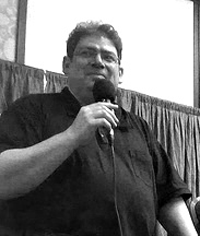
Ben Aaronovitch
By the beginning of June, Cartmel had seen enough of Aaronovitch to know they were on the same wavelength and a story called Transit was incubated. An idea was developed in which a futuristic teleport system had tapped into Hell, and Aaronovitch worked hard on his idea over the summer. Things changed however at the start of September when John Nathan-Turner explained to Andrew Cartmel that he was thinking of bringing back the Daleks. Good news in theory, but the writer for the story would be Aaronovitch – and it meant the scrapping of the promising story Transit.
On 30th October 1987, Nathan-Turner agreed to commission Aaronovitch for a script and, following negotiations with Terry Nation, the Daleks were also secured. The following day, Aaronovitch and Cartmel discussed possible Dalek storylines and exchanged ideas about ways in which 25 years of Doctor Who could be celebrated, whilst weaving in some new mythology.
By mid-November, an outline was coming together and research was done into old Doctor Who stories. The producer responded well to Aaronovitch’s ideas such as a sinister girl shooting electricity and he soon became a familiar sight in the Doctor Who production office. By 18th December 1987, a completed storyline and a draft of episode one had been delivered. The serial was entitled Remembrance of the Daleks to continue the religious theme from earlier stories.
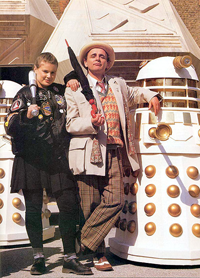
Sylvester McCoy and Sophie Aldred on location
Aaronovitch sought to give the Daleks more credibility and menace, as it was felt they had been the butt of too many jokes over the years. During a lunch with Cartmel, Visual effects designer Mike Tucker had drawn attention to the iconic Emperor Dalek from the sixties comic strips and recalled a conversation he had had with Rob Allsop at college. Allsop had suggested that the dome of the head could open to reveal Davros. Aaronovitch was happy with the idea and included Davros in later revisions of the script.
Development continued into the new year and Aaronovitch incorporated themes of racial purity surrounding both Daleks and humans. He used the civil war theme from Resurrection of the Daleks and Revelation of the Daleks so that the politics of it could be explored, and it also allowed for set-piece battles without any controversy over human casualties.
The script referred to Red Daleks versus Blue Daleks as an easy short-hand and Davros was the leader of the apparently dominant Imperial force. The Daleks loyal to the Black Supreme Dalek were depicted as The Renegades. The Imperial forces were technologically superior with two notable additions to their arsenal that allowed them to overcome the rebel forces.
Davros’s faction had a floating Howitzer gun emplacement, which accompanied the attack squad as they hunted their enemies through London. Aaronovitch also conceived of a special weapon which allowed normal Daleks to fire shots around corners, giving them a tactical edge. It was determined that both these ideas would be achieved using the new visual effects technology called Paintbox.
Exhibition Extras and Restored Renegades
By mid-January 1988 an ambitious ending had been devised and Aaronovitch outlined his finale to the production office. John Nathan-Turner met the synopsis with some cynicism and drew attention to the show’s miniscule budget.
Different FX people were assigned depending on their skills (Not original document)
At the end of January, Aaronovitch pulled an all-nighter to finish episode four which was delivered the next day, complete with some inspired dialogue about rice-pudding. The writer had been so fatigued during the process that he didn’t remember many lines upon reading his own script back.
After a little-game playing by Terry Nation’s agent Roger Hancock, an improved financial deal was struck over the use of the Daleks, and the script was approved. On 11th February 1988, the production team met to research old Dalek stories and the director Andrew Morgan proposed a number of further changes.
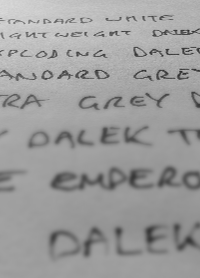
First a list of required Daleks was drawn up (Not original document)
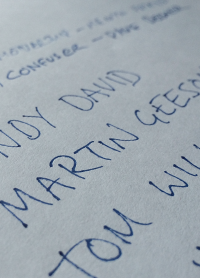
The draft script was then given to the Visual Effects Department for them to start planning, and the FX Designer responsible would be Stuart Brisdon. The first part of his process was to make a list of all the props, and assign a member of his team to each task. Dave Becker was given the “Confuser”, the Hand of Omega and the Emperor to make, whilst Melvyn Friend was given the Shuttle and Mothership. Team members Andy David, Martin Geeson and Tom Wilkinson were amongst those who would be building the Daleks themselves.
After reading the script, and taking onboard the comments of the director about the amount of location and studio work, it was decided that nine “standard” Daleks would need to be made, with the possibility of one being borrowed. Following further discussion and analysis of the script, the breakdown of the necessary props was as follows:
- White Emperor Dalek
- Black Dalek
- Black FX Dalek to Destroy
- 3 x Standard White Daleks
- 1 x Lightweight White Dalek
- 2 x White Exploding Daleks
- 3 x Standard Grey Daleks
- 2 x Extra Grey Daleks
- 1 x Grey Dalek to Crush
The next task was to properly appraise what props were still held in storage and whether any of them could be used – but a continued shift in the way Doctor Who ran its public events was changing the definition of a “BBC Dalek” and new possibilities were opening regarding the TV production.
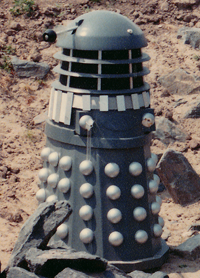
One of many commercial Daleks organised by BBC Enterprises and Martin Wilkie. Photo: Paul Dykes
Martin Wilkie had been involved in creating exhibitions with the BBC throughout the 1970s and 80s and the BBC’s own FX department had supplied Daleks to his various events. For The Liverpool Garden Festival in 1984 a set of new moulds had been made at the BBC so that construction of exhibition props could be simplified. These same moulds were kept at the BBC and they were used to make the Necros Daleks for the next TV serial. When the Liverpool event ended, these charcoal-grey exhibition casings went into Martin Wilkie’s own storage rather than the BBC’s as they were separate from the TV props. They were soon joined by other retired exhibition Daleks when Blackpool closed in 1985.
As a result of Doctor Who‘s commercial activities with the Wilkie team, a second batch of Daleks therefore existed which had been created under the banner of BBC Enterprises rather than the TV show itself. The Enterprises collection was bolstered further when they paid for the refurbishment of a prop for publicity purposes and a casing from the Longleat exhibition was used.
However, unlike the other exhibition Daleks in their care, this Dalek was actually a former TV prop. The lines had become blurred between TV Daleks and exhibition Daleks and it was Dalek N2 from Revelation of the Daleks which ended up painted Black and Silver for BBC Enterprises. It also incorporated components from recently retired 70s exhibition Daleks.
When Stuart Brisdon came to appraise the available Daleks for Remembrance, there was not only a set of canonical TV Daleks but he also had access to the BBC Enterprises collection and a few associated leftovers from exhibitions.
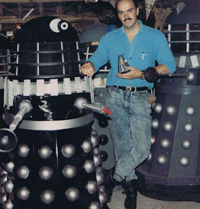
The collection of non-TV props in storage under the watch of Martin Wilkie. Photo – Martin Wilkie
With Dalek N2 having been acquired by BBC Enterprises and Dalek N1 away on exhibition duty, this left only two cream and gold props left over from Revelation. Dalek N4 was in reasonable condition but Dalek N3 was in an extremely sorry state.
In addition to the newer Daleks, the “old guard” of grey props was still in storage, at least two of which would be perfectly serviceable after some refurbishment.
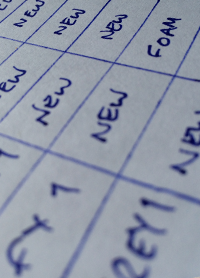
A spreadsheet was created of all the parts (Not original document)
To ensure everyone understood what was needed, Brisdon drew up a spreadsheet to show how many components they had available. He concluded there were enough original parts in storage to build the majority of four Grey Daleks – two would be made from Necros leftovers and two from Shawcraft and Goon components.
With the BBC Enterprises collection available for inspection, the pristine-looking Black Dalek was a ready-made candidate as the leader of the grey Daleks and so it was requested for use. The pool of exhibition parts also allowed other bits to be recycled, such as a set of charcoal-grey shoulders from the Liverpool Garden Festival, neck mesh and odd appendages.
FX Daleks were planned using a mixture of components. The one which had to be “crushed” referred to a Dalek in Totters Yard, onto which a stack of bricks fell. Initially the plan was to share sections between different Daleks throughout production. For example, it was thought that the skirt of the crushed Dalek could also be a white FX Dalek which in turn would be something recycled from storage. It was planned that one of the standard white props would give up its skirt to the Emperor, and then be blown up as part of an FX prop.
The new moulds made by the BBC Plastics department for their White Daleks included all the requisite detail including the slats and raised mesh area. The FX team struck upon the idea of injecting them with foam to make a rough Dalek shape which could be blown up. One of the new foam Daleks was to be sprayed black with silver details to match the prop borrowed from BBC Enterprises. This particular FX dummy was needed during a showdown at the climax of the story when the Supreme Dalek was shot by the Doctor with a rocket launcher.
With this preparation work under way, the script continued to evolve.
Script Sacrifices and Dalek Depression
As Stuart Brisdon’s team were getting stuck into their work, the goalposts were about to be moved.
Producer John Nathan-Turner raised an objection to one of the final scenes in which the Doctor destroys the Black Dalek, saying it was out of character. On 16th February 1988 an impromptu script conference was called in order to solve problems and agree changes. A solution was proposed in which the Doctor talked the Dalek into self-destruction instead. The writers continued to refine episodes one and two in the following days.
Things were still very much in flux and the next sticking point was the extremely expensive visual effect for the floating Howitzer cannon. Despite being a thrilling addition to the action, it was beyond the budget of Doctor Who to realise it as a computer-generated effect and its removal made little difference to the story.
By 14th March 1988, director Andrew Morgan had been shown video tapes of Destiny of the Daleks which provided much of his inspiration on how best to shoot the Daleks. The sets would need ceilings and the props would be seen from below to make them menacing.
Stuart Brisdon’s FX team had been handling the logistics of putting together the Dalek army and, during discussions about the ease of manufacturing new fibreglass sections, it seemed that the idea of additional Dalek firepower could be resurrected.
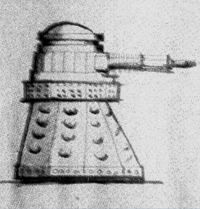
The Special Weapons Dalek Compromise Concept
If a normal Dalek with a special laser could be achieved with a video effect, then why not combine this with the Howitzer cannon idea? A cheap compromise could be reached which would still be exciting – Some standard parts could be easily adapted and a prop could be created which was half Dalek and half gun turret. A simple yet effective solution. Everyone agreed and Brisdon set to work designing something from which Dave Becker could build.
The end of March saw further rewrites until finally a read-through was held on the 28th at the rehearsal rooms.
Stuart Brisdon’s team had been hard at work putting together the Dalek props ready for shooting to begin…
Shades of Grey
The leader of the Renegade Dalek faction arrived at the production of Remembrance of the Daleks ready-made.
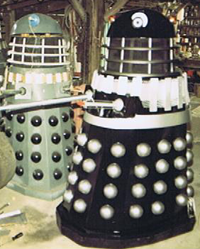
The Supreme Dalek soon after completion in 1987. Photo – Martin Wilkie
In 1987, when BBC Enterprises wanted a Dalek of their own for publicity purposes, they turned to Martin Wilkie and Lorne Martin once again. Since the exhibition props made by the BBC FX teams were generally of a poor standard and not equipped to carry an operator, they would not be suitable for publicity work. Since there was neither the money nor the resources to convert an exhibition shell or build something from scratch, the only logical course was to adapt a former TV Dalek .
Having been at Longleat since Revelation of the Daleks, N2 had been absorbed into the pool of props handled by Martin Wilkie and his team and so it was this Necros Dalek which supplied the skirt and shoulders for the new Enterprises prop. They body was repainted gloss black with the hemispheres and lower collar, silver. The skirt also retained the the rubber drape tacked around the fender.
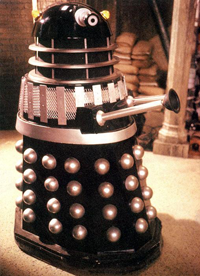
The new Supreme Dalek in studio
Although not sturdy enough for the body of a hero prop, the Blackpool exhibition Daleks donated other parts to complete the new hybrid. The Necros neck cage was dispensed with and one of the exhibition cages with clover style rods was fitted in its place. One of the smaller exhibition eyeballs was fitted instead of the shoddy replica seen at Longleat. A gun was recycled from an exhibition prop gun and extra stages were added to the original arm, which harked back to the early Shawcraft design. The rather haphazard looking upper collar and slats of the Necros prop were also removed and replaced with a much coarser style mesh and tidier slats. Orange dome lights topped off the new creation.
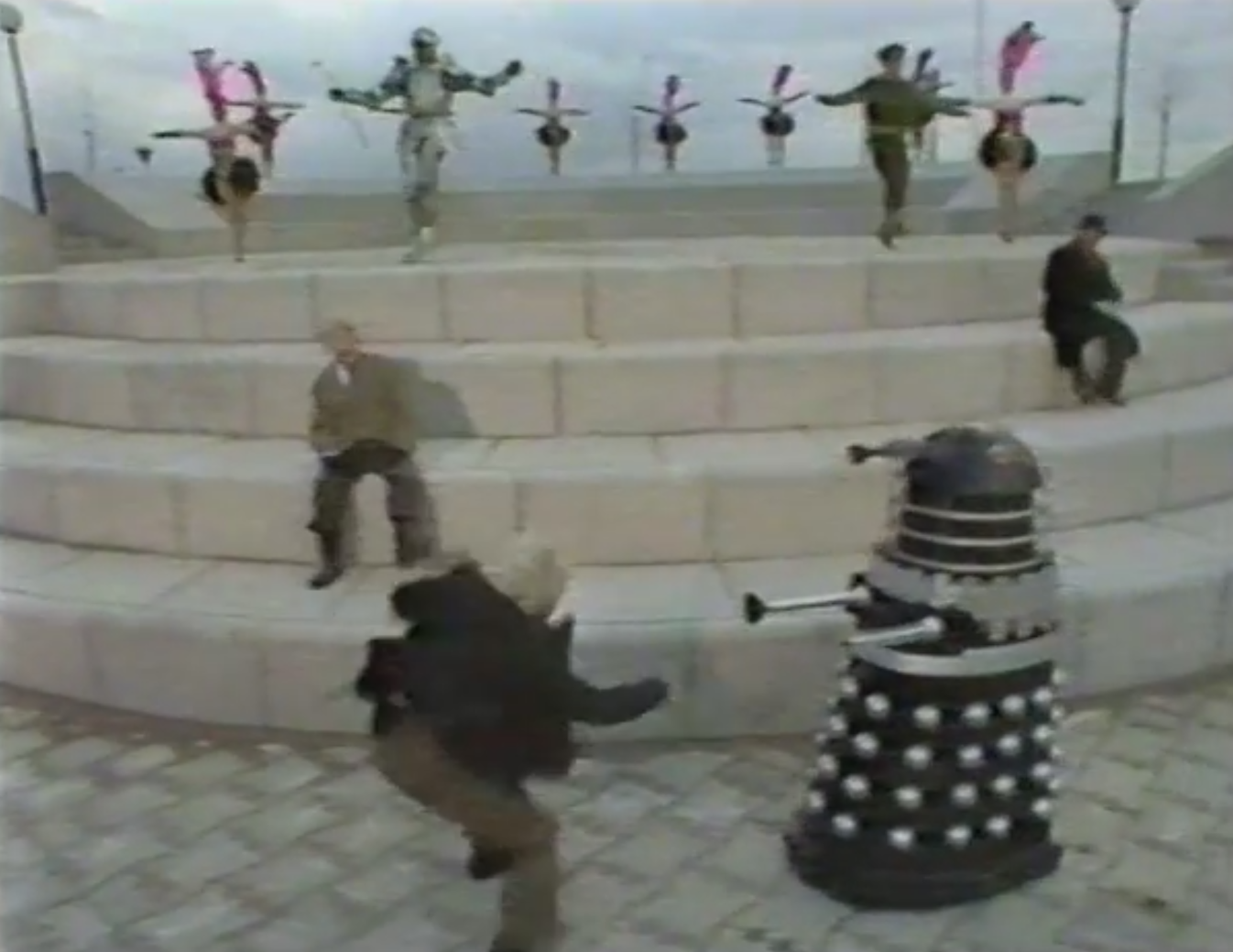
The new look Dalek at the ‘Bafta Craft’ awards
Eagle eyed viewers would have got a very quick glimpse of the ‘new’ Dalek prop if they had watched the 1988 Bafta Craft Awards that were held at the new BBC Studios in Liverpool. In a tribute to costume design, a short sequence was devised featuring The Dougie Squires Dancers dressed in various well-known costumes from famous TV shows. Ronnie Hazlehurst and his orchestra accompanied them as they danced around Liverpool landmarks. The bizarre sequence included a high kicking William Hartnell lookalike emerging from the current Tardis prop only to be confronted with the new look Dalek. The awards were broadcast on 13th March. A video can be seen here.
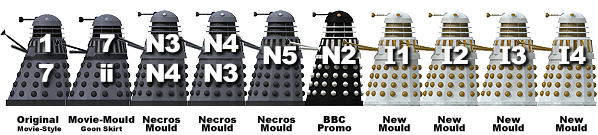
The Renegade force under the command of the BBC Enterprises Dalek was ultimately made up from five props. Two were the long-serving casings – Dalek One-7 and Dalek Seven-ii, two were Necros props from the previous story, and one was made up from new sections.
A long-standing gripe of the effects department and the actors was the metal mesh around the Daleks shoulders which was often painful to handle. A solution was proposed in which a soft material called plastizote would be dappled with a mesh pattern instead to create an illusion of mesh. The slats would then be stuck onto this flat surface, further simplifying the finish as there would be no visible bolts or screws.
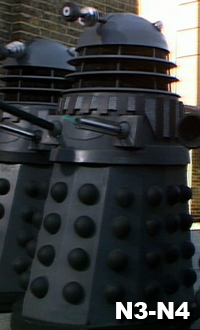
Dalek N3-N4 had seven small slats
Brisdon tasked team member Tom Wilkinson with refurbishing the first of the Necros Daleks that would become a Renegade. As his own pet project, Wilkinson was allocated the badly damaged Dalek N3 and he was given a box of parts to salvage as best he could. He carefully reconditioned the prop all over, smoothing the surface at the front of the gunboxes, adding a new rubber fender and fitting the neck properly on the shoulders. Following on from the colours set in the previous tale, it was given a predominantly grey paint scheme with black fender and hemispheres.
Due to this Dalek being worked on independently by Wilkinson, a number of unique features occurred. Dalek N3 was given seven small slats over the gunboxes, whereas the others would have six, and its lower collar remained light grey, whereas the others were painted black. His eye stalk also differs from those cast from the new mould which had been created.
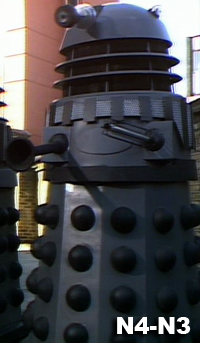
Dalek N4-N3 attacks the school
Dalek N4 needed less work as it was in reasonable condition. It had new rubber fitted on the fender but it retained all its Necros components save for a new eye. It required only the new style fake mesh fitting, plus a coat of paint. Before going into production, the two halves of the old Necros props became swapped over creating Dalek N3-N41 and Dalek N4-N3.
The fifth prop to complete the troop was a hybrid creation. Although not appearing in the previous story on the planet Necros, it is still termed Dalek N5 because its shoulders and skirt comes from the same moulds.
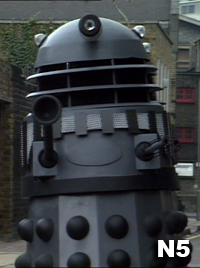
Dalek N5 with its distinctive narrow gun and arm boxes
The difference which sets this shoulder section apart from the true Necros Daleks, is how the limbs are mounted. A new method was being used in the Imperial Daleks and so this set was done the same way. Instead of having a wooden plate passed through the shoulders to widen the gunboxes and hold the limbs, plastizote was used to loosely hold them in. The system was not very strong and the operator of the prop would have to ensure the pivots didn’t collapse into the body. It also meant the boxes were left in their original ‘narrow’ form meaning its easier to pick out these newer shoulders from the older batch.
The skirt wasn’t fitted with the rubber drape that the other Necros props had, but instead the lower recessed stage was left visible and painted black. Rather than create a new neck, yet another of Wilkie’s spares was used, this time from a Blackpool exhibition Dalek. The mesh of the exhibition neck bin had a unique square pattern opposed to the usual diamond or hexagon style. A new dome was fabricated to complete the hybrid N5.
The older props Dalek One-7 and Dalek Seven-ii needed work to get them to match the moulded style of all the newer props. Both Daleks had the areas behind the lower collars filled to give them the solid ‘shelf’ of the Necros props. Dalek One-7 kept its original dome that it had been paired with since the 1970s, although the neck cage had been swapped for a Goon type, the upper most rods of which were bent inwards to avoid fouling the dome. Due to their condition, the hemispheres of its skirt were ‘capped’ which made them appear larger. Dalek Seven-ii received the ‘Shawcraft style’ neck cage and Goon dome.
White Supremacy
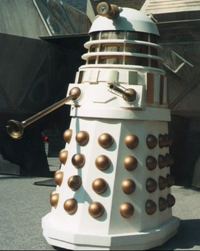
The new Imperial Dalek
To portray the Imperial Daleks it was decided that four completely new props would be made. Using an existing Necros-style shoulder as a basis, a modified plug was created which had a raised edge to represent the mesh, and then blocks for slats added too. This allowed a new mould to be created which had all the essential features of a shoulder section built-in and identical fibreglass casts could be made quickly and easily.
The neck cage was also created in fibreglass as a solid drum with extruded rods and rings. The rods were tapered to ensure they came out of the mould easily. Six panels were cut out of the neck bin for the operators to see. The skirts were made from the same mould which had been created by the BBC Plastics workshop for the Liverpool Garden Festival and matched the shape of the Necros props.
Keen to make the arm look less like a sink plunger, the new Imperial props were given a more conical appendage with notches like an ash-tray. They were solid and designed to slot into the set’s control panels. The old off-the-shelf lights were replaced as they too were considered very ordinary and prone to mockery. A completely new, bespoke, flat design was created from EMA parts.
The Imperials were given a white finish with gold highlights to maintain continuity with Davros’s forces in the previous story. The slats and neck bin were covered in a gold foil, and the neck bin had sequin waste (also known as punchinella) slotted into its windows.
As with the Renegades’ new eyes, they were cast solid in resin but finished in gold and white with a silver iris. The guns and arms were mounted using the new method that was used for Dalek N5.
The new moulded nature of the props made them difficult to differentiate however, as with the Necros props, there are small tells in the arrangement of the hemispheres and marks on the shoulders. Additionally each individual section was given a number on the inside to be sure each prop fitted back together correctly.
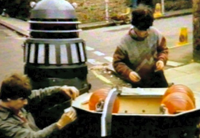
New fender drapes are fitted to cover the new wheelbarrow movement system
As extensive location work was needed on uneven surfaces, a new way of moving the props was devised. Instead of boards or rails that had been used in the past, large spherical wheelbarrow wheels were fitted to a frame which also incorporated the operator’s seat. They were arranged with two at the back and a single steerable wheel at the front. Although this made it easier to move on rough ground, the props had a tendency to wobble from side to side. The operators had to steer them like cars so that three-point turns had to be performed, unlike the old Daleks which could swivel nimbly on the spot. Extra standard castors were included in the framework and where surfaces were even only the castors were used.
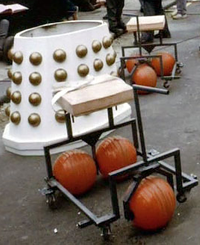
The new wheelbarrow wheel movement system
The floating weapons platform and the special Dalek gun from Aaronovich’s original script had been scaled back and unified into a new idea: A practical prop which was half Dalek and half cannon. Stuart Brisdon had completed a sketch which depicted a rivet-covered mid-section and fender, armoured plates where the “slats” should be, and a huge, elongated gun turret. The weapon incorporated discs like a Dalek eye stalk as well as having rails.
The job of construction was handed over to FX assistant Dave Becker. The skirt was a standard one and the shoulder section was a new cream casting using the moulds created for the Garden Festival. The lower collar was studded with rivets all around as per the design sketch, but the upper area was left bare.
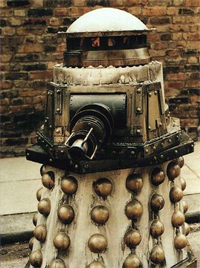
The Special Weapons Dalek
The design of the gun was modified slightly from the concept so that it was shorter, and fitted to a drum that allowed the barrel to be directed up or down. The the gun barrel was adorned with plastic plant pot trays, MDF discs and other EMA parts. Stock fake wooden rivet heads were used all over.
The domed top of the head was a standard Imperial dome cut down and the neck was a modified black plastic bin. Silver foil was fixed inside the windows of the neck section to give it some consistency with its normal comrades. Finally it was heavily weathered to give it a battle-weary appearance and the new beast was complete. It was a very cheap construction but a very effective design.
Explosive Happenings
Taping of the serial began in Theed street on Bank Holiday Monday 4th April. This was the location chosen for Ratcliffe’s yard and scenes involving just the Renegade props were completed. As had always happened over the years, sections were swapped between props and Dalek N5 was briefly fitted with the 70s Goon neck cage and dome for some scenes here.
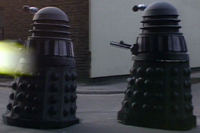
Lightweight SFX Renegade Daleks
At the same time, a second unit was also taping at nearby Wootton Street near Waterloo station. This would be the first use of the four Imperial Daleks. The initial shots included those of the Special Weapons Dalek moving into position to destroy two Renegade Daleks. Three of the Renegade props were transferred from Theed Street with Dalek Seven-ii and Dalek N5 (with its proper neck cage and dome now refitted) the unlucky two chosen to be destroyed. However two lightweight SFX Daleks stood in for the actual destruction. These were the dummies which had been created by injecting foam in into the imperial moulds and as such all FX Daleks had the Imperial Daleks’ hexagon shape on the front.
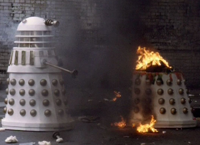
Dalek I2 (left) and the skirt of Dalek I4 at Wootton Street
The next sequence was one of the main battle scenes under a railway bridge. This time the third Renegade Dalek, Dalek N4-N3, joined Dalek N5 to battle the four Imperial Daleks. As this scene was set prior to the previously taped scenes, the Special Weapons Dalek was not involved. The two Renegades were able to repel the four Imperial Daleks and the skirt of Imperial Dalek 4 (or Dalek I4) was used with a SFX top section in a spectacular pyrotechnic shot. This was the first of the Imperials to be destroyed.
The second Imperial Dalek to be hit was Dalek I2. This time the full prop was used. The gun was removed and an SFX version fitted in its place. The barrel of the gun was lightweight balsa wood so it would fall out on the detonation of a small charge placed behind it in the socket. On cue the charge was set off just leaving minor black charring to the box and shoulder area. It is possible to notice that the lower fender stage of Dalek I2 had been damaged and a large hole had appeared. The battles at the bridge utilized so many large explosions that car alarms were set off nearby and the Police and Fire Brigade were called in to investigate.
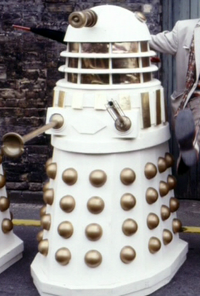
Dalek I1 at Theed Street
On 5th April the team moved back to Theed Street to tape the Imperial Dalek attack on the Renegade Daleks at the yard. Already the Imperial props were starting to look a little shabby. Their paint was easily marked and touch-ups were constantly required. The foil areas of the neck frequently became crumpled and needed replacing or straightening. By day two the foil iris of Dalek I1 was already missing and one hemisphere was misaligned. The lower fender of Dalek I2 had been patched up before the day’s work was complete.
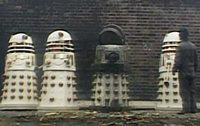
Damaged Imperial Daleks after an explosion
Another significant pyrotechnic effect was required when the Imperials break through the gate. Far exceeding the appropriate amount of explosives, the resulting blast completely destroyed the gate, disrupted the recording equipment and damaged the Daleks. Hemispheres were blown off the Imperial Daleks which were supposed to emerge from the smoke, and the head of the Special Weapons Dalek was tipped backwards off the shoulders. The shot had to be edited early to hide the condition of the props and the Imperials needed refurbishment before production could continue.
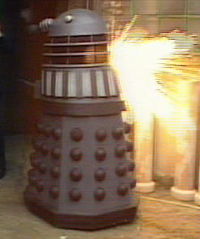
Dalek N5 is hit
Further shots of the attack on the yard included a shot of Dalek N5 being destroyed. The effect was achieved by placing a charge onto the neck bin of the prop and on cue the prop was pulled forward by hidden wires to simulate the laser strike.
Kew Bridge Steam Museum was the team’s next location on the 6th and 7th of April. The area was acting as the scrap yard first seen in An Unearthly Child in 1963. Here the scene was completed which featured the army’s first encounter with the Renegade Daleks. Dalek N3-N4 was the prop chosen for the battle. The set-piece was designed to end with the destruction of the Dalek thanks to some Nitro-9.
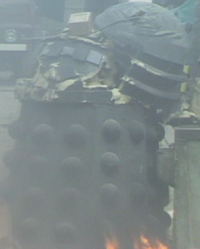
The SFX prop at Kew Bridge Steam Museum
A lightweight SFX shoulder and neck section were formed using foam injected into the Imperial Dalek mould. The shot on screen is just about brief enough to hide the fact the prop had changed faction and has a hexagon on the front! Because the Dalek was supposed to be crushed by a fall of bricks, revealing the creature and machinery inside, no hero parts were to be used. Instead, the unused FX skirt created for Revelation of the Daleks was used. The skirt already included mutant remains and two panels that were cut away and replaced by lightweight versions that were rigged to fly-off. Unfortunately the trigger didn’t work and the panels remained intact, so the mechanics inside were never revealed. The skirt would be reused again in studio but with extra Dalek gore added.
The next location for the Daleks would also hark back to An Unearthly Child. St. John’s CE Junior and Infant School at Macbeth Street was the double for Coal Hill School. Taping commenced on the 9th April and early scenes included the climax to episode two and opening of episode three. Imperial Daleks I1, I3 and I4 surrounded Ace.
When the three props came to be destroyed, several more foam FX sections were used. The shot was lined up carefully with Dalek I3 and Dalek I4 in the foreground with dummy necks and heads, and Dalek I1 remained obscured at the rear due to having dummy shoulders as well.
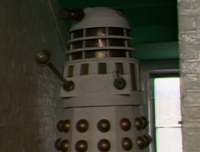
Dalek I3 is lifted up the stairwell
Continuing the theme of addressing old Dalek jokes, a scene was devised to show a Dalek traveling up a flight of stairs. Although floating Daleks had been attempted in Revelation of the Daleks, this story would be the first time a Dalek would be seen chasing someone up a set of steps.
Stuart Brisdon’s FX team laid two scaffolding poles up the stairs to create a set of rails. Onto this was placed a leveling rig with four “V wheels” which slotted over the tubes. Out of the rear of the leveling rig ran two handles like a wheel-barrow which allowed members of the FX crew to push the whole unit smoothly up and down. When the Dalek was lowered onto the rig, the handles would have protruded through the lower fender, so two rectangular slots had been cut into the fibreglass to allow for this.
The camera was positioned so that the rig and operators were just below frame, as Dalek I3 was pushed gently up the incline.
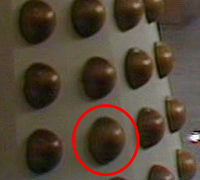
Dalek I3s larger replacement hemisphere
Ace’s scenes in the classroom and her subsequent escape down the stairwell were also filmed at this time. Firstly with Dalek I3 set in place at the top of the stairs it had just come up, Ace would run past and strike the prop with her baseball bat. This attack splintered the fibreglass of the skirt and knocked one of the hemispheres off which needed to be replaced. However the replacement was noticeably larger than the original and would remain so for the remaining recording time.
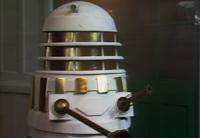
Dalek I2 is battered by Ace in the classroom
The classroom scene in which Ace attacks a Dalek did not run smoothly. In the initial take, Sophie Aldred wasn’t informed that Dalek I2 had yet to have its FX eyestalk installed. She continued to assault the prop causing a small amount of damage. When the prop was reset with the correct eyestalk it was done over several takes. Close up shots show some black residue to areas of the shoulders which aren’t apparent in the longer shots, illustrating that the prop was cleaned up midway through the shooting of the scene. Upon hitting the dome, not only did Aldred knock off the light but also dislodged one of the batteries housed in the dome. This bounces off the neck rings and falls to the floor. Unsurprisingly, the lights then stop working.
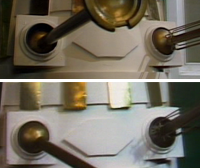
The Imperial Daleks had problematical boxes
The new gun box pivot retention system was particularly unreliable in this scene. Instead of sitting snugly in their socket, the appendages tended to sink back into the box.
One of the most spectacular location sequences featured an Imperial Dalek shuttlecraft landing at the school. Instead of using model work or a video effect, a full sized prop was built and winched into place by a crane. The shuttle was able to hold three Daleks but a video “wipe” transition was cleverly used to make it appear that a fourth disembarked. It is the first time video effects of any kind were used to increase the apparent number of Dalek props – but ironically not beyond the four that actually existed!
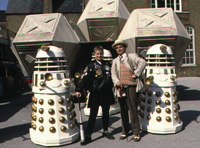
Refurbished Imperial Daleks with the shuttle craft
A photocall was arranged and the stars were snapped with the four Imperial Daleks and their shuttle. The props had undergone some refurbishment since their last use. The gold slats’ surfaces were prone to showing dirty finger marks and so these were cleaned up or in some cases replaced entirely. More touch up paint was also applied to both the body and hemispheres.
Dalek N3-N4, Dalek N4-N3 and Dalek N5 took most of the Renegade limelight, with the 60s/70s mix of Dalek Seven-ii being kept to the rear in most shots. Although Shawcraft original Dalek One-7 was taken to the location and used it didn’t actually appear in the transmitted location footage, but it did make it into the background of a promotional photograph of the Supreme Dalek.
Stairs Again? No Problem
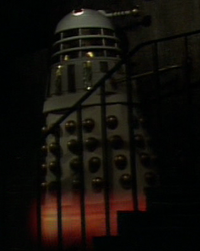
Imperial Dalek I1 defeats the stairs
The team moved into the studio for three days of taping beginning on 27th April 1988 where Dalek One-7 made its brief, and final, appearance in Doctor Who. It was on screen for a few seconds in the yard office set.
Another scene was set up to depict a Dalek floating up a cellar stairwell in the school, this time coming at the climax of episode one. As the Dalek was shot from side and the rear, the method used on location had to be adapted slightly so that the FX crew propelling the Dalek were concealed by the set. Post production helped obscure the rig to complete the effect. A wire was again used to turn the dome during the scene but unfortunately this is clearly seen in the final footage.
To complete the scene of the Dalek leaving the cellar Dalek I3 was reused. The school reception set was built several feet off the floor to allow the deception that there was a stairwell beyond the door and the lifting mechanism used to with Dalek I3 at the location stairwell was employed again.
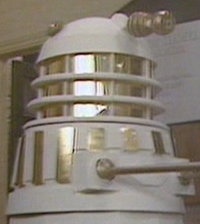
Dalek I2 with SFX neck and dome
The same set was used for the scene of Ace destroying an Imperial Dalek with the anti-tank gun. Dalek I3 initially attacks the Doctor and Ace but Dalek I2 with SFX neck section was swapped into its place to complete the effect. The complete Dalek I2 was also used at the controls of the interior of the shuttle craft.
Studio work would also see the first appearance of the impressive new Dalek Emperor, the design of which resembled the look of the Emperor Dalek from the 1960s Dalek comic strips. The large, spherical top section was constructed from a leftover prop from the Bodymatters medical show.
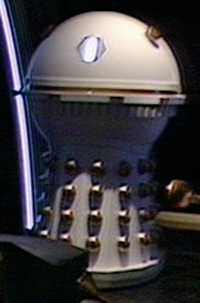
The Emperor Dalek which utilised the skirt of Dalek N5
As only three of the grey Renegade Daleks would be required briefly in studio, it was decided that Dalek N5 should give up its skirt section to save money. It was repainted in the Imperial livery and paired with the new top section to complete the Emperor prop. This decision effectively orphaned the top section of Dalek N5. The Emperor had no arm or gun and its eye was a backlit hexagonal shape flush with the surface of the dome.
Towards the end of episode four the Doctor would video link to the mothership (which itself had design nods back to the 60s comic strip) to confront the Emperor who reveals himself to be Davros. The dome slid apart to reveal the actor inside, with Terry Molloy again playing the part.
Molloy, being of smaller stature and needing to sit up high to be in the correct position, found it hard to reach the floor to propel the prop with his feet. Therefore the holes in the skirt, previously made for Dalek N5’s destruction scene, were reused to thread wires so that the prop could be pulled into position.2 Davros, this time, appeared to have lost further elements of his humanoid form.
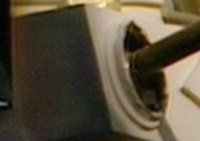
Remodelled box detailing on Dalek I4, after previous damage
All four Imperial props were also used in the final mothership scenes with Dalek I1 at the main control board in the centre of the set. The control board had previously been used in the scenes set within the Dalek shuttle craft.
Again the Imperial Daleks had been tidied up, and the cut-out sections of Dalek I3s fender (to the left of Dalek I1) were covered up. The detailing around the gun and arm sockets had been patched up as it was prone to cracking and breaking. This is most noticeable on Dalek I4 to the right of Dalek I1 where the rim was now of a rougher appearance.
A Final End?
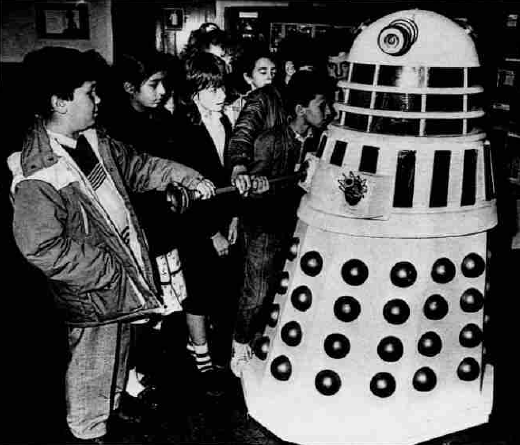
An Imperial Dalek at Acton High School. Click for a larger view.
Remembrance of the Daleks began Season 25 of Doctor Who on 5th October, 1988 and excited children got up close to one of the new Imperial Daleks during the transmission period of the story when 400 children from schools across Ealing were invited to Acton High School for a ‘Space-day.’
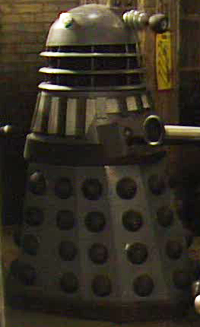
Dalek One-7’s brief and final appearance
Remembrance of the Daleks would be the last appearance of Dalek One-7 and Dalek Seven-ii in a Doctor Who studio. It was fitting that the final Dalek serial of the original run featured one full top section of a Shawcraft Dalek prop built in 1963, and another almost fully complete prop from 1965. They had lasted some 25 years and were a great testament to the skill of Bill Roberts’ original team at Shawcraft and the quality of the props they made for the show.
The classic series finished just a year later with the end of Season 26 but the Daleks would still feature on television for years to come. Some would be screen used props, and some would be clones manufactured from the last sets of moulds made.
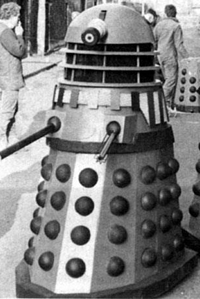
Dalek Seven-ii on location
The early nineties would see several attempts to restart the show, culminating in 1996 with a full Television Movie being made with the co-operation of the Americans and starring Paul McGann. It is a sign of the importance of Terry Nation’s creations that they were even afforded a tiny audio role in this otherwise unrelated adventure.
But, as time passed, the Daleks would increasingly become oddities of a past age – referred to no longer by excited children but only by wistful parents, mentioned during recollections of a much-loved television programme.
The Daleks that had once been frightening spectres on screen were increasingly seen only as museum pieces. But the longer Doctor Who was off air, the more the museums closed, and the battered and neglected props faded into obscurity.
But thanks to the dedication of a handful of collectors, some props were not forgotten. Five decades after they were first wheeled out, the Daleks still survive in garages and living rooms around the world…
Next Page: Where Are They Now?
-
The shoulders of Dalek N3 can be tracked by an imperfection in its gun pivot hole. With the skirt sections also having unique hemisphere placements we are able to see that the shoulders of Dalek N3 and Dalek N4 swap skirts.
-
As recalled by Terry Molloy in an interview with Aaron J Climas – Thanks to Aaron J Climas.