Events from Jul 63 to Dec 63

How It All Began
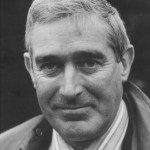
Terry Nation – Creator of the Dalek Concept
When Doctor Who began, its creators had a remit to include an element of learning. Loosely speaking, the show was designed to alternate between historical stories, and futuristic stories in which the story hinged on scientific concepts and discussed cultural differences with aliens. The first ever Doctor Who story saw the time-travelers visit primitive humans, and their second adventure took them to the futuristic world of Skaro, an idea submitted by a television writer called Terry Nation. He was formally commissioned to write his story on 31st July 1963.
This story dealt with the idea of nuclear war and, as the names of the early drafts illustrate, it also explored the ideas of “The Survivors” and “The Mutants”. This was an extremely raw topic coming only a year after the Cuban Missile Crisis had brought the world to the brink of nuclear war. In Terry Nation’s script, the outcome of the war was to leave a world divided into two opposing factions, one passive and one aggressive, borrowing ideas from H. G. Wells’ “The Time Machine”. In a later story it would even note that this adventure on Skaro had taken place “a million years” in the future – not far off the year 802,701 A.D. which was the setting for “The Time Machine”.
The Doctor and his companions explore a planet on which Terry Nation had let his imagination run riot. The time-travelers discover a metallic animal in the forest called a Magnadon which the Doctor deduces has evolved to hold its similarly metallic prey in a magnetic field. A city is then discovered, built by more metallic creatures, called Daleks. Does this hint at a forgotten idea? Was there a time when the Daleks, like the Magnadon, were supposed to be a naturally-evolved form? Foreshadowing their meeting in the city, the Doctor asks Ian, “Can’t you imagine an animal unless it’s flesh, blood and bone?” And add to this the fact that both the Magnadon and the Daleks share common features – a curved body with flat metal panels, protuberances sprouting from the surface, plus eyes on stalks – there’s more than a hint of a shared metal evolution.
But whether this was really ever the case, it is soon explained that The Daleks are a race whose genetic mutation has left them confined to metal travel machines which the script described as follows: “Hideous machine-like creatures, they are legless, moving on a round base. They have no human features. A lens on a flexible shaft acts as an eye. Arms with mechanical grips for hands.”
The Dalek Design and Build
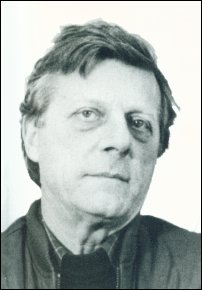
Raymond P Cusick – Creator of the Dalek Shape
The designer originally assigned to this serial was Ridley Scott, who would later make a name for himself as a director of films such as Bladerunner, Alien and Gladiator. When his availability fell through, another BBC employee called Raymond Cusick was assigned. From the description in the prose, Cusick started to develop concepts, and he took on-board the fact that Nation had recently enjoyed the graceful movement of Georgian State Dancers.
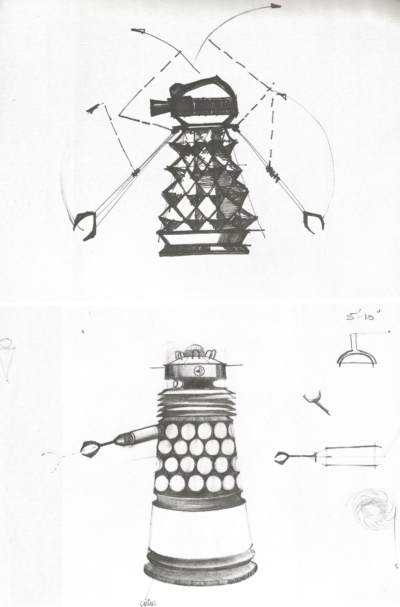
An early concept design by Ray Cusick
Cusick collaborated with various people to iron out the practicalities of these props including BBC trainee, Jeremy Davies.
Davies recalls, “Ray had overall responsibility and so had to oversee everything, but all the sets, including the Daleks were a collaborative effort between Ray, Bill Roberts at Shawcraft and myself. My role was to help develop ideas and, of course, provide ideas of my own. Most of the background equipment and machinery was done by Shawcraft with Ray and I left to develop the Daleks from Ray’s sketches. The end result didn’t look much like either Ray’s original sketches or mine. It was the result of the practicalities of housing a person that could move the machine with his feet. The original idea was Ray’s, but the end result was a team effort with, as I remember it, Bill Roberts sorting out how it worked and me being responsible for drawing it up and getting it built. As for the final result, I would say it was 50% Ray, 25% me and 25% Bill, but all that is open to argument and 50 years later, who can tell exactly!”*
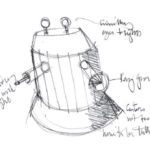
A Jeremy Davies sketch
Interviewed for the Liverpool Weekend Echo in 1977, Nation stated that round-table meetings were fevered and, “it was impossible to think coherently so I begged for a quiet weekend. At the time I had no ideas at all and none of my drawings seemed to make sense. Then at the very last minute, my wife was cooking bacon and eggs and I discovered I had lifted up the pepper pot without thinking. The Daleks were literally in the palm of my hand!”
Cusick also alleges that it was during one of their lunches that a pepper pot was supposedly used to illustrate to Bill Roberts (of Shawcraft Models) how the Daleks should look when in motion1.
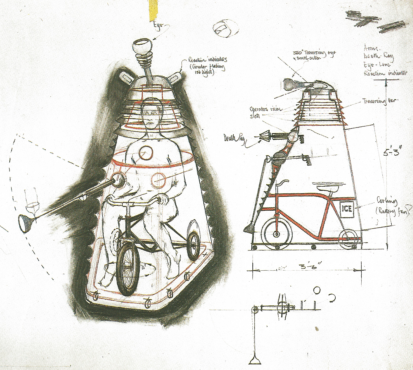
Cusick’s initial idea for a trike inside the Dalek
The initial concepts for the Dalek props had centred around the simple, and cheap, idea of a man dressed in a robot-like suit but gradually the designs were refined. With much to-ing and fro-ing between Cusick and Davies, a more cylindrical shaped object began to form based on the pepper pot notion and from pushing it around a table while simulating the motion of the previously mentioned Georgian State Dancers1.
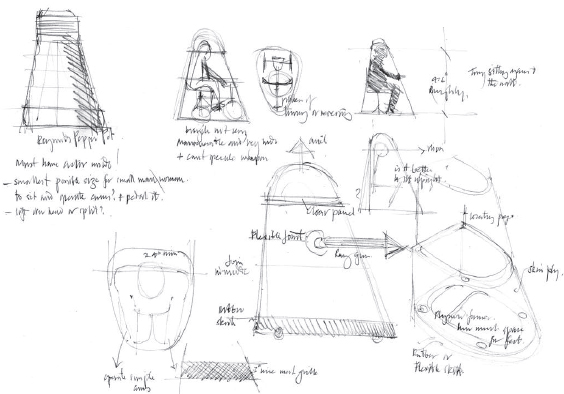
Draughtsman Tony Webb was measured for sizing purposes
The props had to be large enough to accommodate an operator but still remain compact. A louver section in the neck was necessary to allow the operators to see, and propulsion by tricycle was discussed but proved impractical. Cusick recalls that his original idea was to have a smooth, cylindrical skirt but he steered away from this in the mistaken belief that the props would be constructed from timber and so he ensured the design of lower half of the Dalek was angular.
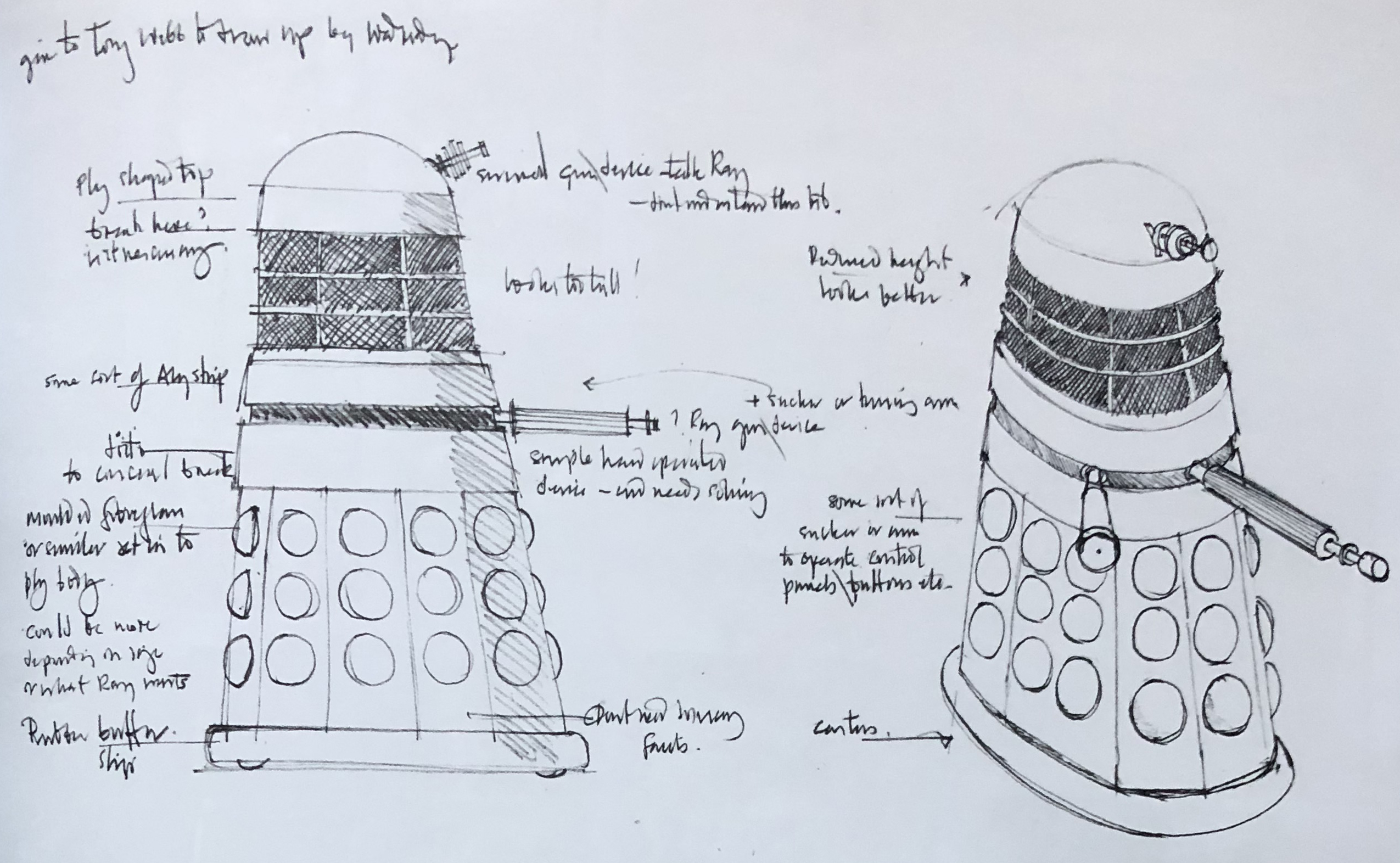
One of Davies’ final sketches is close to the final form
One of the key men who helped realise the Daleks was Bill Roberts, the man behind Shawcraft Models. The BBC outsourced Doctor Who work to Shawcraft because their own internal visual effects department couldn’t handle the load. Since Shawcraft lacked the carpentry staff, the Daleks were constructed mainly from fibreglass, but Cusick learnt of this too late to reinstate his original desire for a cylindrical skirt.
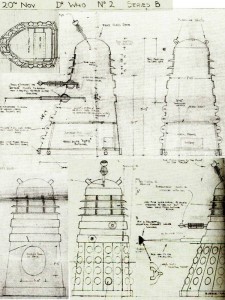
The “Zero 20th Nov” Plans
Shawcraft’s contribution to the final design can never truly be measured but Ray Cusick acknowledges Bill Roberts put his own ingenuity into the creation of the props, such as suggesting the inclusion of a camera’s diaphragm shutter to act as an eye.
What purport to be the oldest available plans of a Dalek are credited to draftsman A. Webb (Tony Webb) based on Cusick’s outlines and Davies’ sketches (Webb also had a small part to play in the actual design of the Daleks as it had been he who had sat on a chair against a wall for Cusick and Davies to measure for the general size of the props). The plans themselves are headed “Zero 20th Nov” which would have been the deadline for the project and they are dated 29/10/632.
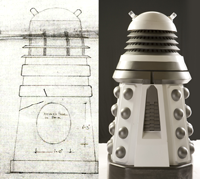
“Hinged Panel in Base” says the original plans
2010 Dalek on right right with secret panel
It is curious that these plans should differ so much from Davies final sketches and the actual final design. Perhaps the plans were simply over-ambitious and Shawcraft had to take the liberty of adapting them to the budget.
Regardless of the relationship of the plans to the project, it is interesting to note the gun and arm are set at different levels, each rotating around their own chrome band, apparently making sense of the ‘collars’ which are seen on the Dalek which make it to screen.
In the cross-section diagram the arm has no attachment and the accompanying note says that “the end is tailored to allow fitting of various items. Suction Pad, Pincers, etc.” On both external labels and on the cross-section, the Dalek’s hemispheres were shown to be illuminated.
Those familiar with the Daleks 2010 redesign will find it interesting to note the fact that these plans show no hemispheres on the rear panel, and instead an oval shape at the back was in fact a “hinged panel in base.”3
The Four Dalek Props
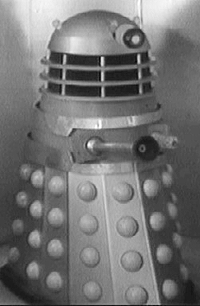
The first Dalek design
The props were robustly built and finished by Shawcraft to a high standard, costing less than £1000 in total. At a glance, the props all looked identical in their pristine livery of silver, grey and blue. The collars were of smooth, highly-reflective metal and the fibreglass hemispheres were made in a very sky-blue. The eye stalks were adorned with nine blue discs and the guns were intricately crafted from metal rails and perspex octagons. The fenders were coated in cut segments of black carpet underlay which would have not only helped muffle the sound of their wheels in studio, but also dampened the gentle sounds of collision as the props bumped against each other on set.
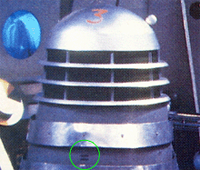
The Dalek identifying dashes
Despite the high quality of their construction, each prop has its own unique characteristics which means they can be tracked throughout their first serial and also in future stories. There are a wide variety of identifying features, some of which are inherent in the build and some of which are more transient marks which only last until a prop is refurbished. Their immaculate appearance soon started to suffer from transportation and the everyday operation of the props caused wear-and-tear.
In order to help match each Dalek top and bottom section together, the four Daleks were numbered using one, two, three or four horizontal dashes on their rear between the collars and at the top of the skirt although our own prop numbering system doesn’t follow this system.**
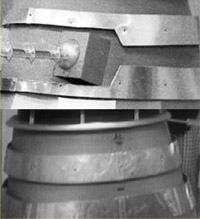
Misaligned collars on Dalek One (above) The identifying marks on the rear (below)
Dalek One‘s key feature is that the collar beneath the gunboxes is noticeably thinner than its counterparts and there is a slight lift at the front. The collars are mounted very unevenly and they are not parallel to each other. The vertical rods of the neck cage have a flat top to them. In addition to the single horizontal ‘number one’ mark at the rear, there is also a small mechanism below the neck, presumed to be related to the latch that prevents Ian escaping from inside the casing. The skirt of this Dalek also has an unpainted bolt in the centre of the rear panel. More subtle traits include a small paint run on one of the skirt panels, and the positioning of the screws which hold on the collars.5
Independent researcher Robert Kew has suggested that Dalek One had a gun fitted with perspex rails although evidence is inconclusive. If true, then along with the differently-cut and badly-aligned collars it would suggest that Dalek One had a degree of “trial and error” in its construction.6
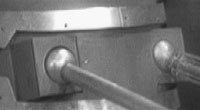
Dalek Two’s small gun ball
Dalek Two is harder to spot at a glance. A keen eye will note however that the lower front collar is fractionally broader than its upper collar and the hole for the gun’s ball-joint is smaller than the arm-hole. Like Dalek One, it has flat-top neck rods. When seen from behind, as well as the useful two dashes between the collars, there is a small nick in the rim of the dome. Probably the easiest identifier during this story is that the right-hand face of the arm-box has and noticeable black smear.
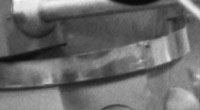
Dalek Three’s screw less lower collar
Dalek Three has several unique features which make it easy to identify. Beneath the gun and arm box there should be two screws holding the lower collar in place, but for some reason Dalek Three lacks these fixings. Unlike the first two props, the neck cage’s vertical rods are chamfered at the top. Another difference is that the screw at the very front of the top collar is at its extreme lower edge, whereas the other props have their screw mounted centrally. It also has a bolt in the rear skirt panel like Dalek One however this one is painted over and appears paler.
As well as these handy construction quirks, this is the prop for which Bill Roberts cannibalised an old camera to provide an iris which could open and close. Not only that, but this Dalek had an electromagnet fitted into the plunger making it even more distinctive, and it is also fitted with a cutting torch for one sequence. In addition, this prop has its fair share of damage and marks, including a crescent shaped scar at the front of the skirt, and a black smear on the left rear corner panel.
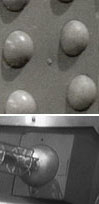
Features of Dalek Three & Four
Most dramatically, Dalek Three is the victim of some rough treatment in episode seven during the final battle. The top collar receives some impromptu remoulding when Barbara smashes it with a large rock, causing a huge buckle, and moments later Ian flings one of the magnetic restraints, taking a sizeable chunk out of the top neck ring, and forcing the lower rings apart so that they are no longer parallel to each other.
Dalek Four is less identifiable although one noticeable feature is that the gun and arm’s ball-joints protrude more than usual. There is a slight lift at the front of the lower collar and the screw beneath the arm-box is further from the centre than its corresponding gun-box screw. It also has flat topped neck rods. Aside from these minor clues, it is often easier to identify Dalek Four using a process of elimination.
The Daleks on Set
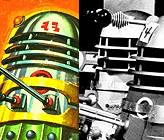
Artwork incorporating sellotape reels
Shawcraft took just under four weeks to make the Daleks. From Tuesday 29th October when the final design drawing was completed, to Friday 22nd November when the four props were delivered to the car park at Lime Grove ready for their first studio session.
The four props were originally fitted with fixed castors, affording them a relative limited range of movement. After episode two was recorded an effort was made to address this, so the props were sent back to Shawcraft on 25th November and a new set of wheels were fitted. From episode three onwards, the props are considerably more mobile, able to performing spins on the spot. Michael Summerton, one of the operators, was sent to Shawcraft to take part in manoeuvrability tests.7
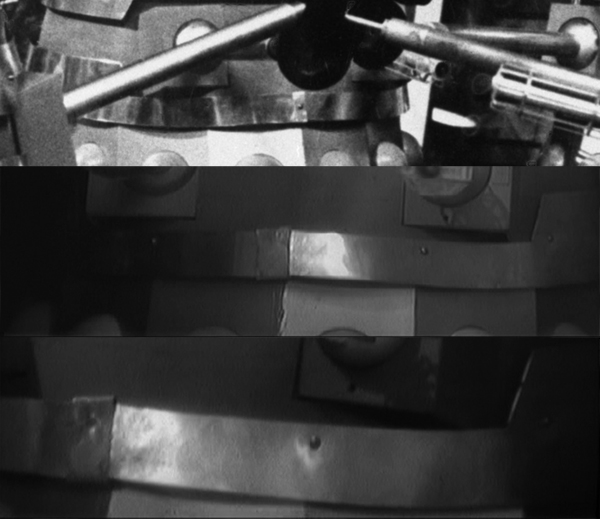
The changes to Dalek Four’s collar joiner. Click for a larger view.
Other less visible changes took place between rehearsals for episode two and its final recording. Dalek Four started out with a central screw in its lower front collar joiner. The other three props had their screws close to the top of the band. This was changed twice. Initially to a wider band for episode two, then in later episodes, gaining the higher positioned screw.
Once in studio it was very difficult to choreograph the Daleks’ movements as the director couldn’t tell which operator was in which prop. The unique identifying marks between the collars were not helpful when the director was in the gallery so numbers were stuck to the domes, and coloured tape rolls were jammed in the shoulder braces for rehearsals. Pictures from these rehearsals were unfortunately used as reference by merchandise producers and inaccurate drawings of Daleks soon appeared in annuals with a speaker grille inspired by the tape roll, and with numbers on the casings.
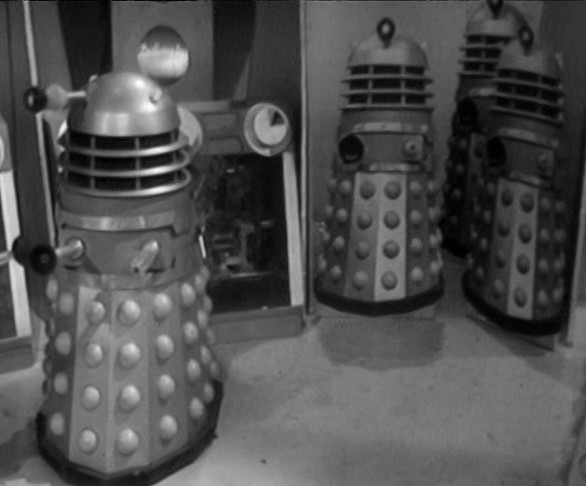 The numbers used for rehearsal reference are not to be confused with the numbering marks between the collars at the back. There was frequently a disparity between the two.
At least nine life-sized photographic blow-ups were used on the right-hand side of the control room set and they can also be seen casting peripheral shadows in the scene where the Doctor and Susan are recaptured.
The recording of episode one proved unusable due to a technical fault. Episode two was recorded on 22nd November 1963.
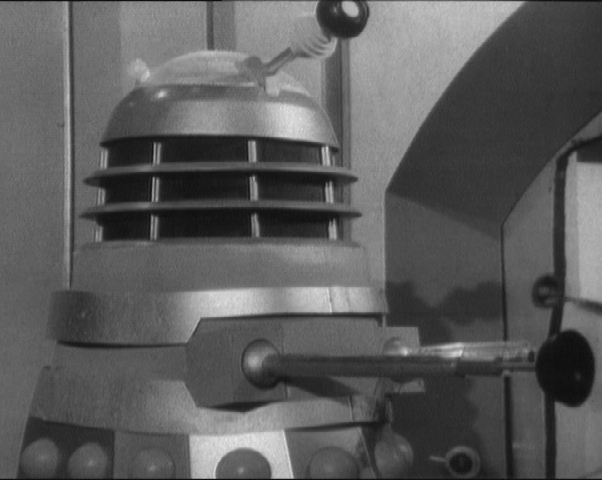 In addition to the four main props, a fifth FX prop was roughly assembled from a mixture of proper components and collapsible elements in order to be destroyed. This explosion was filmed for the lift sequence on 26th November at Ealing. Episode three was then recorded on 29th November and episode one was recorded again on 6th December. Episode four was therefore set back a week to 13th December and episode five was recorded on 20th December.
On 28th December the Daleks were revealed in full to the world when episode two, entitled The Survivors was broadcast on BBCtv, and reception to the Daleks was immediately positive. It must have been been a buoyant atmosphere in studio during the recording of episode six on January 3rd with the country becoming feverish about the television being created. The final episode’s recording saw the serial completed on 10th January 1964.
Doctor Who‘s viewing figures had been improving greatly in the wake of their new phenomenon. Their first television outing may have ended, but behind the scenes the story of the Dalek props themselves was only just beginning.
Away from the television cameras, the props had already been required to go above and beyond the call of duty, and their off-screen adventures had already begun.
*Thank you to Richard Bignell for the information and images regarding the involvement of Jeremy Davies.
**This is due to a lack of clear images of the rear of each of the Daleks when compiling this information. To clarify, Daleks One and Two do match their markings whereas Daleks Three and Four are swapped. Our numbering remains constant from this point.
Next Page – Publicity and Charity
-
This inclusion is based on Ray Cusick’s interview on the BBC DVD release of The Chase, however, Cusick also claims in The Early Years to have had the same infamous lunch using pepper pots with director Chris Barry and Mervyn Pinfield. Maybe he just had a lot of lunches.
-
A number of sketches exist which portray rejected ideas for Dalek designs, but the true nature of one element of these drawings is somewhat debatable. Three Daleks of wholly contrasting styles exist including a “see-through” design revealing how the operator would steer a tricycle inside and lights that were included on the dome section. Cusick himself, in later interviews, stated that lights were added as an afterthought after the props were built, rendering this image somewhat confusing!
-
The 2005 redesign of Dalek honours the 1963 plans since the original concept seems to have been to have the limbs able to rotate around the shoulder section on their metal bands. The metal bands were retained but the rotation presumably was too costly. In 2010, the designers responsible for the revamp of the props explained in Doctor Who Confidential that they were asked to bring something new to the design, unseen in the old props so they included a panel which could open and rotate new attachments around to the front of the props. This was never shown on screen.
-
The old Dalek 63•88 site stated £500 for all four props based on Cusick’s recollection from Daleks – The Early Years. An alternative figure of £1000 was arrived at based on Cusicks alleged recollections which were reported in The History of Broadcasting in The United Kingdom Volume 3 in which he states that the props had to cost “no more than £250 each”. The latter ties in more accurately with the known cost of the film props which were very similar in construction.
-
The screws on the collar of Dalek One are closer to the edge where the collar changes from thick to thin. Also, these diagonal edges are set quite far back.
-
Robert Kew recalls conversations with Ray Cusick who mentioned an experimental perspex version made by Shawcraft for costing, and the plans do mention this concept. There is a curious on-set photo where Dalek One has a cardboard tube over the gun – perhaps protecting the delicate appendage. Some photos do hint at a degree of transparency to the rails, but others seem to depict normal metal rails.
-
According to the DVD notes for The Daleks.